恓 (xī) means "Grieved; desolate" in Chinese. It has 9 strokes with the radical 忄.
Rated 4/5 in difficulty (challenging).
Appears in 3+ common words including 恓惶 (xī huáng), 恓恓 (xī xī), 恓切 (xī qiè).
Due to its 9 strokes, Hanzi Writer's error detection shows 恓 requires focused practice — most learners need 10+ attempts for consistent accuracy.
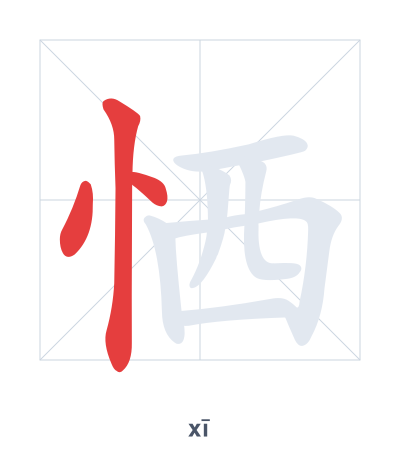
Open Hanzi Writer to see the animated stroke order and practice writing 恓 with real-time feedback.
The character 恓 (xī) is written with 9 strokes. Follow the standard Chinese stroke order: top to bottom, left to right, outside before inside. The radical 忄 is one of its key components.
Practice the correct stroke order with the Hanzi Writer app to see animated stroke-by-stroke guidance with real-time feedback.
恓 means Grieved; desolate.
The character 恓 is a compound of the heart radical 忄 (indicating emotion) and 西 (xī, 'west'). The west wind traditionally symbolizes autumn, a season of decay and sorrow, so together they evoke a heart feeling grieved or desolate.
💡 Memory Tip: Picture a heart (忄) caught in a cold west wind (西), shivering with grief.
他的样子很恓惶。
tā de yàng zi hěn xī huáng
He looks distressed and anxious.
别再恓恓惶惶了。
bié zài xī xī huáng huáng le
Stop being so anxious.
听着声音很恓切。
tīng zhe shēng yīn hěn xī qiè
The sound is very mournful.
Open Hanzi Writer to see the animated stroke order and practice writing 恓 with real-time feedback.
✨ Animated stroke order · Handwriting recognition · HSK-graded practice · Free to use
The character 恓 is composed of the radical 忄 (heart) on the left and 西 (west) on the right. The heart radical indicates that the character relates to emotions or feelings, while 西 provides the pronunciation (xī) and also evokes the traditional association of the west with autumn and melancholy. Together, they suggest a heart filled with grief or desolation.