邬 (wū) means "Wu (a surname)" in Chinese. It has 6 strokes with the radical 阝.
Rated 2.9/5 in difficulty (moderate).
Appears in 3+ common words including 邬先生 (wū xiān shēng), 姓邬 (xìng wū), 邬家 (wū jiā).
Hanzi Writer's stroke validation shows learners typically need 5-8 attempts to write 邬 with correct proportion and order.
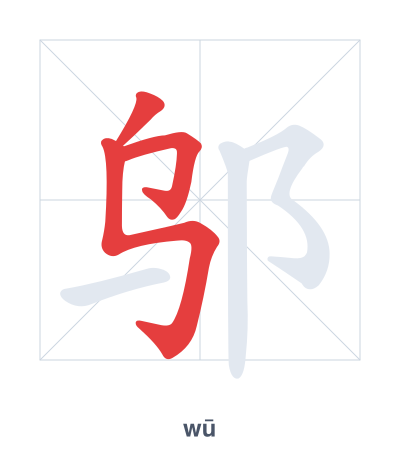
Open Hanzi Writer to see the animated stroke order and practice writing 邬 with real-time feedback.
The character 邬 (wū) is written with 6 strokes. Follow the standard Chinese stroke order: top to bottom, left to right, outside before inside. The radical 阝 is one of its key components.
Practice the correct stroke order with the Hanzi Writer app to see animated stroke-by-stroke guidance with real-time feedback.
邬 means Wu (a surname).
邬 is a compound character where the left component 乌 (wū, meaning 'crow' or 'black') gives the sound and hints at the meaning, while the right radical 阝 (representing a mound or settlement) indicates a place name. Historically, it referred to a town in ancient China, possibly named after crows or dark soil, and later became a surname.
💡 Memory Tip: Picture a crow (乌) perched on a hill (阝) that belongs to a family named Wu.
邬先生在看报纸。
wū xiān shēng zài kàn bào zhǐ
Mr. Wu is reading a newspaper.
她姓邬,不姓吴。
tā xìng wū bù xìng wú
Her surname is Wu (邬), not Wu (吴).
这是邬家的老房子。
zhè shì wū jiā de lǎo fáng zi
This is the old house of the Wu family.
Open Hanzi Writer to see the animated stroke order and practice writing 邬 with real-time feedback.
✨ Animated stroke order · Handwriting recognition · HSK-graded practice · Free to use
邬 is made of the radical 阝 (meaning 'place' or 'city') on the left and the phonetic component 乌 (wū, meaning 'crow' or 'black') on the right. The radical suggests a place name, and 乌 provides the pronunciation, so 邬 is a surname that originated from a place called Wu.