渥 (wò) means "To moisten or enrich" in Chinese. It has 12 strokes with the radical 氵.
Rated 4.2/5 in difficulty (advanced).
Appears in 3+ common words including 渥太华 (wò tài huá), 优渥 (yōu wò), 渥然 (wò rán).
Due to its 12 strokes, Hanzi Writer's error detection shows 渥 requires focused practice — most learners need 10+ attempts for consistent accuracy.
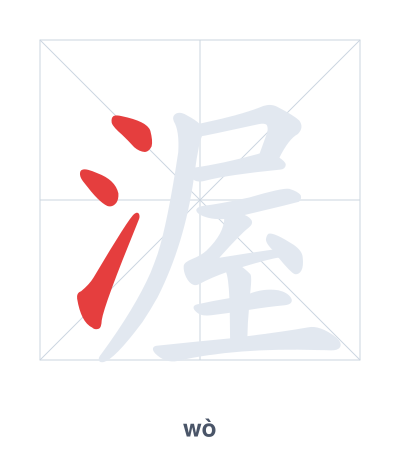
Open Hanzi Writer to see the animated stroke order and practice writing 渥 with real-time feedback.
The character 渥 (wò) is written with 12 strokes. Follow the standard Chinese stroke order: top to bottom, left to right, outside before inside. The radical 氵 is one of its key components.
Practice the correct stroke order with the Hanzi Writer app to see animated stroke-by-stroke guidance with real-time feedback.
渥 means To moisten or enrich.
This compound character combines the water radical 氵 (water) with 屋 (house, which also hints at pronunciation). The image of water soaking or enriching a house conveys the meaning 'to moisten or enrich.'
💡 Memory Tip: Imagine water (氵) dripping steadily onto a house roof (屋) to moisten and enrich the wood.
渥太华在加拿大。
wò tài huá zài jiā ná dà
Ottawa is in Canada.
这里的待遇很优渥。
zhè lǐ de dài yù hěn yōu wò
The benefits here are very generous.
他的脸色渥然。
tā de liǎn sè wò rán
His complexion is rosy and glowing.
Open Hanzi Writer to see the animated stroke order and practice writing 渥 with real-time feedback.
✨ Animated stroke order · Handwriting recognition · HSK-graded practice · Free to use
渥 is composed of the water radical 氵 on the left, which suggests moisture or liquid, and the phonetic component 屋 (wū, meaning house or room) on the right. The combination implies water covering or enriching something like a house, so the character means to moisten or enrich.