沃 (wò) means "Fertile / To irrigate" in Chinese. It has 7 strokes with the radical 氵, and is HSK Level 7.
Rated 3.5/5 in difficulty (challenging).
Harder than 19% of HSK Level 7 characters.
Appears in 3+ common words including 肥沃 (féi wò), 沃土 (wò tǔ), 沃野 (wò yě).
Due to its 7 strokes, Hanzi Writer's error detection shows 沃 requires focused practice — most learners need 10+ attempts for consistent accuracy.
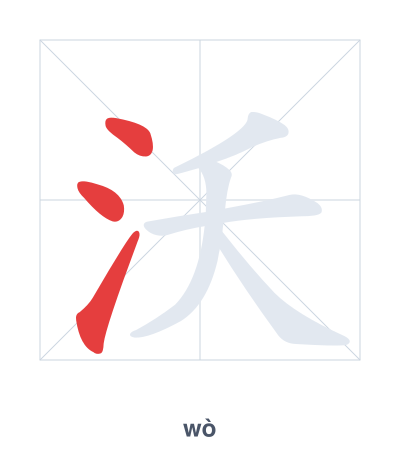
Open Hanzi Writer to see the animated stroke order and practice writing 沃 with real-time feedback.
The character 沃 (wò) is written with 7 strokes. Follow the standard Chinese stroke order: top to bottom, left to right, outside before inside. The radical 氵 is one of its key components.
Practice the correct stroke order with the Hanzi Writer app to see animated stroke-by-stroke guidance with real-time feedback.
沃 means Fertile / To irrigate.
As an HSK Level 7 character, 沃 is an intermediate-level character.
沃 combines water (氵) with 夭, which originally depicted a person bending or twisting—suggesting water that twists through fields to irrigate them, thereby making the soil fertile.
💡 Memory Tip: Picture water (氵) pouring over a twisted, bent plant (夭), and suddenly it shoots up lush and fertile.
这里的土地很肥沃。
zhè lǐ de tǔ dì hěn féi wò
The soil here is very fertile.
沃土适合种菜。
wò tǔ shì hé zhòng cài
Fertile soil is suitable for growing vegetables.
窗外是一片沃野。
chuāng wài shì yī piàn wò yě
Outside the window is a stretch of fertile land.
Open Hanzi Writer to see the animated stroke order and practice writing 沃 with real-time feedback.
✨ Animated stroke order · Handwriting recognition · HSK-graded practice · Free to use
沃 is composed of the radical 氵 (water) on the left and 夭 (yāo, meaning 'young' or 'tender') on the right. The water radical suggests irrigation, while the right component hints at new growth, together conveying the idea of making soil fertile through watering.