Hanzi Writer

How to Write 魏 (wèi) — Meaning “Wei”

wèi 17 strokes Radical: 鬼

魏 (wèi) means "Wei" in Chinese. It has 17 strokes with the radical 鬼.

Rated 4.2/5 in difficulty (advanced).

Appears in 3+ common words including 姓魏 (xìng wèi), 魏国 (wèi guó), 魏碑 (wèi bēi).

Due to its 17 strokes, Hanzi Writer's error detection shows 魏 requires focused practice — most learners need 10+ attempts for consistent accuracy.
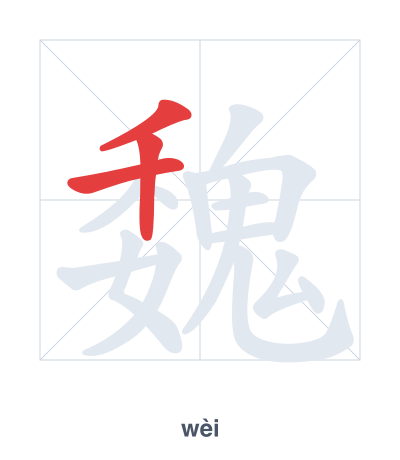
Stroke order practice for 魏 - wèi

Practice Writing 魏 (wèi)

Open Hanzi Writer to see the animated stroke order and practice writing 魏 with real-time feedback.

The character (wèi) is written with 17 strokes. Follow the standard Chinese stroke order: top to bottom, left to right, outside before inside. The radical is one of its key components.

Practice the correct stroke order with the Hanzi Writer app to see animated stroke-by-stroke guidance with real-time feedback.

means Wei.

Character
Pinyinwèi (wei)
MeaningWei
Strokes17
Radical
Difficulty4.2/5

魏 is a phono-semantic compound: 委 (wěi) provides the sound, while 鬼 (guǐ, ghost) adds meaning, possibly referencing the ancestral spirits of the ancient State of Wei. The character was historically used for a powerful feudal state during the Zhou dynasty, and its visual form merges the concept of a ghost with an entrusting gesture (委 literally shows a woman kneeling under grain).

💡 Memory Tip: Imagine a ghost (鬼) entrusting (委) a woman with the task of guarding the great State of Wei.

xìng wèi
Surname Wei
wèi guó
State of Wei
wèi bēi
Wei stele calligraphy

他姓魏,是我的老师。

tā xìng wèi shì wǒ de lǎo shī

His surname is Wei, and he is my teacher.

魏国是一个古老的国家。

wèi guó shì yí gè gǔ lǎo de guó jiā

Wei was an ancient state.

他在练习写魏碑。

tā zài liàn xí xiě wèi bēi

He is practicing Wei stele calligraphy.

Character Pinyin Strokes Radical
(current) wèi 17
15
yǎn 15
xiāo 16
Stroke order practice for 魏 - wèi

Practice Writing 魏 (wèi)

Open Hanzi Writer to see the animated stroke order and practice writing 魏 with real-time feedback.

✨ Animated stroke order · Handwriting recognition · HSK-graded practice · Free to use

Frequently Asked Questions about 魏

魏 is composed of two parts: the radical 鬼 (ghost or spirit) on the right, and the phonetic component 委 on the left. The left side 委 (wěi) hints at the pronunciation, while the right side 鬼 suggests a supernatural or ancient connection, as the character historically refers to a state or clan name.

Characters with Radical 鬼

Other 17-Stroke Characters