渭 (wèi) means "Wei (referring to the Wei River)" in Chinese. It has 12 strokes with the radical 氵.
Rated 4.2/5 in difficulty (advanced).
Appears in 3+ common words including 渭河 (wèi hé), 渭水 (wèi shuǐ), 泾渭 (jīng wèi).
Due to its 12 strokes, Hanzi Writer's error detection shows 渭 requires focused practice — most learners need 10+ attempts for consistent accuracy.
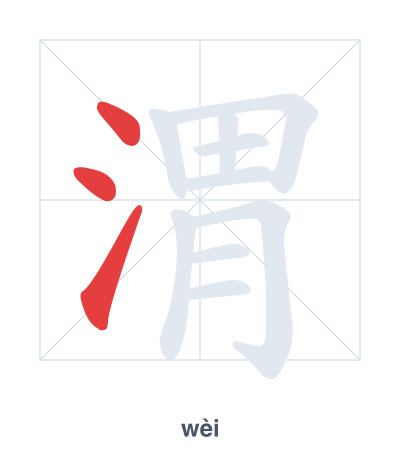
Open Hanzi Writer to see the animated stroke order and practice writing 渭 with real-time feedback.
The character 渭 (wèi) is written with 12 strokes. Follow the standard Chinese stroke order: top to bottom, left to right, outside before inside. The radical 氵 is one of its key components.
Practice the correct stroke order with the Hanzi Writer app to see animated stroke-by-stroke guidance with real-time feedback.
渭 means Wei (referring to the Wei River).
渭 is a phono-semantic compound combining the water radical 氵 (river) with 胃 (wèi, stomach) for phonetic guidance. It specifically denotes the Wei River, a major tributary of the Yellow River in China.
💡 Memory Tip: Imagine the Wei River winding through the land like a watery stomach (胃) digesting the landscape.
渭河在陕西省。
wèi hé zài shǎn xī shěng
The Wei River is in Shaanxi Province.
渭水流向东方。
wèi shuǐ liú xiàng dōng fāng
The Wei River flows to the east.
泾渭分明是一个成语。
jīng wèi fēn míng shì yí gè chéng yǔ
'Jing Wei Fen Ming' is a Chinese idiom.
Open Hanzi Writer to see the animated stroke order and practice writing 渭 with real-time feedback.
✨ Animated stroke order · Handwriting recognition · HSK-graded practice · Free to use
渭 is composed of the radical 氵 (water) on the left, which indicates the character relates to a river or water. The right part is 胃 (wèi, stomach), which provides the pronunciation hint. Together, 渭 specifically names the Wei River.