Hanzi Writer

How to Write 桅 (wéi) — Meaning “mast”

wéi 10 strokes Radical: 木

桅 (wéi) means "mast" in Chinese. It has 10 strokes with the radical 木.

Rated 4.2/5 in difficulty (advanced).

Appears in 3+ common words including 桅杆 (wéi gān), 桅灯 (wéi dēng), 桅顶 (wéi dǐng).

Due to its 10 strokes, Hanzi Writer's error detection shows 桅 requires focused practice — most learners need 10+ attempts for consistent accuracy.
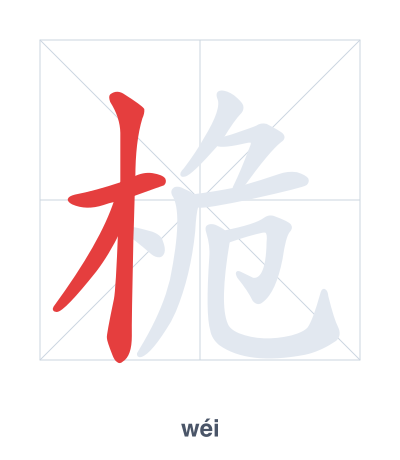
Stroke order practice for 桅 - wéi

Practice Writing 桅 (wéi)

Open Hanzi Writer to see the animated stroke order and practice writing 桅 with real-time feedback.

The character (wéi) is written with 10 strokes. Follow the standard Chinese stroke order: top to bottom, left to right, outside before inside. The radical is one of its key components.

Practice the correct stroke order with the Hanzi Writer app to see animated stroke-by-stroke guidance with real-time feedback.

means mast.

Character
Pinyinwéi (wei)
Meaningmast
Strokes10
Radical
Difficulty4.2/5

桅 is a compound character combining the radical 木 (tree/wood) with 危 (danger). Since a mast is a tall wooden pole on a ship that must withstand stormy seas, the component 危 suggests its precarious, dangerous position high above the deck.

💡 Memory Tip: A wooden mast (木) stands tall amid danger (危) as the ship pitches in a raging storm.

wéi gān
mast (of a ship)
wéi dēng
masthead light; lantern
wéi dǐng
masthead; top of the mast

船上有一根高桅杆。

chuán shàng yǒu yī gēn gāo wéi gān

There is a tall mast on the boat.

桅灯在夜里很亮。

wéi dēng zài yè lǐ hěn liàng

The masthead light is very bright at night.

鸟儿停在桅顶上。

niǎo ér tíng zài wéi dǐng shàng

The bird perched on the masthead.

Character Pinyin Strokes Radical
(current) wéi 10
miǎo 8
háng 8
bēi 8
Stroke order practice for 桅 - wéi

Practice Writing 桅 (wéi)

Open Hanzi Writer to see the animated stroke order and practice writing 桅 with real-time feedback.

✨ Animated stroke order · Handwriting recognition · HSK-graded practice · Free to use

Frequently Asked Questions about 桅

桅 is made of the radical 木 (wood/tree) on the left and the component 危 (wēi, meaning 'danger' or 'high') on the right. The 木 shows that a mast is made of wood, while 危 hints that a mast is tall and can be dangerous on a ship. Together, they form the character for a ship's mast.

Characters with Radical 木

Other 10-Stroke Characters