呑 (tūn) means "to swallow" in Chinese. It has 7 strokes with the radical 口.
Rated 3.5/5 in difficulty (challenging).
Appears in 3+ common words including 呑没 (tūn méi), 呑吐 (tūn tǔ), 呑并 (tūn bìng).
Due to its 7 strokes, Hanzi Writer's error detection shows 呑 requires focused practice — most learners need 10+ attempts for consistent accuracy.
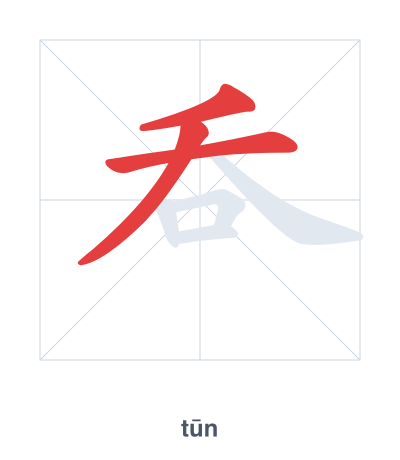
Open Hanzi Writer to see the animated stroke order and practice writing 呑 with real-time feedback.
The character 呑 (tūn) is written with 7 strokes. Follow the standard Chinese stroke order: top to bottom, left to right, outside before inside. The radical 口 is one of its key components.
Practice the correct stroke order with the Hanzi Writer app to see animated stroke-by-stroke guidance with real-time feedback.
呑 means to swallow.
呑 is a compound character with 口 (mouth) below and 天 (sky) above. The image suggests a mouth swallowing something as vast as the sky, representing the act of gulping down or engulfing.
💡 Memory Tip: Picture a giant mouth (口) opening wide to swallow the entire sky (天) — that's one big gulp!
大海呑没了一切。
dà hǎi tūn méi le yī qiè
The sea swallowed everything.
他说话呑呑吐吐的。
tā shuō huà tūn tūn tǔ tǔ de
He speaks hesitatingly.
公司被呑并了。
gōng sī bèi tūn bìng le
The company was acquired.
Open Hanzi Writer to see the animated stroke order and practice writing 呑 with real-time feedback.
✨ Animated stroke order · Handwriting recognition · HSK-graded practice · Free to use
The character 呑 consists of the radical 口 (mouth) on top of 天 (sky). The mouth above the sky suggests the action of swallowing something as vast as the sky, which connects to its meaning "to swallow."