菟 (tú) means "dodder (a parasitic plant)" in Chinese. It has 11 strokes with the radical 艹.
Rated 4.2/5 in difficulty (advanced).
Appears in 3+ common words including 菟丝子 (tú sī zi), 菟葵 (tú kuí), 菟丝 (tú sī).
Due to its 11 strokes, Hanzi Writer's error detection shows 菟 requires focused practice — most learners need 10+ attempts for consistent accuracy.
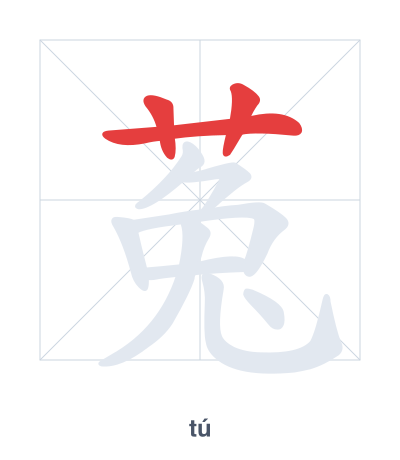
Open Hanzi Writer to see the animated stroke order and practice writing 菟 with real-time feedback.
The character 菟 (tú) is written with 11 strokes. Follow the standard Chinese stroke order: top to bottom, left to right, outside before inside. The radical 艹 is one of its key components.
Practice the correct stroke order with the Hanzi Writer app to see animated stroke-by-stroke guidance with real-time feedback.
菟 means dodder (a parasitic plant).
菟 is a phono-semantic compound: the grass radical (艹) indicates it is a plant, while 兔 (rabbit) provides the pronunciation tú. Dodder is a parasitic vine that twines around other plants like a tangled rabbit's fur.
💡 Memory Tip: Imagine a rabbit (兔) tangled in dodder vines (艹) — the parasitic plant wraps around it like green thread.
菟丝子是中药。
tú sī zi shì zhōng yào
Dodder seed is a traditional Chinese medicine.
菟葵开花了。
tú kuí kāi huā le
The winter aconite has bloomed.
菟丝缠绕在树上。
tú sī chán rào zài shù shàng
The dodder is winding around the tree.
Open Hanzi Writer to see the animated stroke order and practice writing 菟 with real-time feedback.
✨ Animated stroke order · Handwriting recognition · HSK-graded practice · Free to use
The top part is 艹, the grass radical, showing this character represents a plant. The bottom part is 兔 (rabbit), which gives the pronunciation tú and visually suggests the dodder plant's twisting vines, similar to a rabbit's movement.