绨 (tí) means "A type of heavy silk" in Chinese. It has 10 strokes with the radical 纟.
Rated 4.2/5 in difficulty (advanced).
Appears in 3+ common words including 绨袍 (tí páo), 粗绨 (cū tí), 绨几 (tí jǐ).
Due to its 10 strokes, Hanzi Writer's error detection shows 绨 requires focused practice — most learners need 10+ attempts for consistent accuracy.
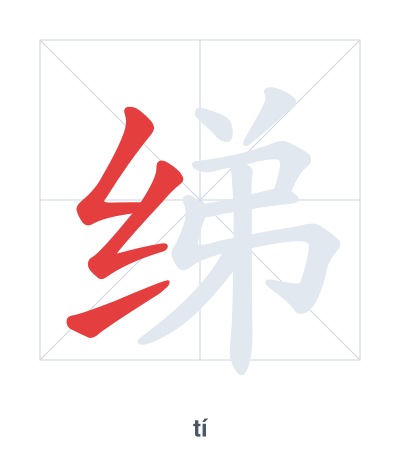
Open Hanzi Writer to see the animated stroke order and practice writing 绨 with real-time feedback.
The character 绨 (tí) is written with 10 strokes. Follow the standard Chinese stroke order: top to bottom, left to right, outside before inside. The radical 纟 is one of its key components.
Practice the correct stroke order with the Hanzi Writer app to see animated stroke-by-stroke guidance with real-time feedback.
绨 means A type of heavy silk.
This is a phono-semantic compound. The radical 纟 (silk thread) indicates it relates to silk fabrics, while 弟 (originally 'younger brother') serves as a phonetic component to approximate the pronunciation tí, together forming the word for a heavy silk fabric.
💡 Memory Tip: Imagine a younger brother (弟) wrapped tightly in heavy silk (纟), sweating from the weight.
他穿着一件绨袍。
tā chuān zhe yī jiàn tí páo
He is wearing a coarse silk robe.
这种布料叫粗绨。
zhè zhǒng bù liào jiào cū tí
This fabric is called coarse tiffany.
绨几放在窗边。
tí jǐ fàng zài chuāng biān
The silk-covered small table is placed by the window.
Open Hanzi Writer to see the animated stroke order and practice writing 绨 with real-time feedback.
✨ Animated stroke order · Handwriting recognition · HSK-graded practice · Free to use
The left side is the radical 纟, which means silk or thread, showing that 绨 is related to textiles. The right side is 弟, which gives a clue to the pronunciation (tí) but does not directly relate to the meaning of heavy silk.