厗 (tí) means "Ti (rare character used in names)" in Chinese. It has 9 strokes with the radical 厂.
Rated 3.7/5 in difficulty (challenging).
Appears in 3+ common words including 厗阳 (tí yáng), 姓厗 (xìng tí), 厗首 (tí shǒu).
Due to its 9 strokes, Hanzi Writer's error detection shows 厗 requires focused practice — most learners need 10+ attempts for consistent accuracy.
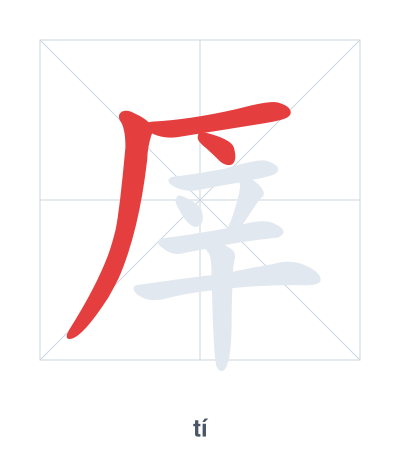
Open Hanzi Writer to see the animated stroke order and practice writing 厗 with real-time feedback.
The character 厗 (tí) is written with 9 strokes. Follow the standard Chinese stroke order: top to bottom, left to right, outside before inside. The radical 厂 is one of its key components.
Practice the correct stroke order with the Hanzi Writer app to see animated stroke-by-stroke guidance with real-time feedback.
厗 means Ti (rare character used in names).
| Character | 厗 |
| Pinyin | tí (ti) |
| Meaning | Ti (rare character used in names) |
| Strokes | 9 |
| Radical | 厂 |
| Difficulty | 3.7/5 |
厗 is a compound character with the cliff radical 厂 and the component 辛 (bitter/spicy), which may serve as a phonetic element. Its original meaning is obscure, and it is extremely rare, used only in personal names.
💡 Memory Tip: Imagine a steep cliff (厂) where a rare, bitter herb (辛) grows, so unusual that it's only used as a unique name.
厗阳是一个古地名。
tí yáng shì yí gè gǔ dì míng
Tiyang is an ancient place name.
很少有人姓厗。
hěn shǎo yǒu rén xìng tí
Few people have the surname Ti.
这是一个古老的词。
zhè shì yí gè gǔ lǎo de cí
This is an ancient word.
Open Hanzi Writer to see the animated stroke order and practice writing 厗 with real-time feedback.
✨ Animated stroke order · Handwriting recognition · HSK-graded practice · Free to use
厗 is built from the radical 厂 (cliff) on top and 辛 (spicy or bitter) below. The radical gives a sense of a cliff or overhang, while 辛 is mainly phonetic in this rare name character, so the meaning is not directly connected to the components. It is an old character used in ancient names and place names, so the structure is more about form than semantic composition.