搪 (táng) means "to ward off or coat" in Chinese. It has 13 strokes with the radical 扌.
Rated 4.2/5 in difficulty (advanced).
Appears in 3+ common words including 搪塞 (táng sè), 搪瓷 (táng cí), 搪住 (táng zhù).
Due to its 13 strokes, Hanzi Writer's error detection shows 搪 requires focused practice — most learners need 10+ attempts for consistent accuracy.
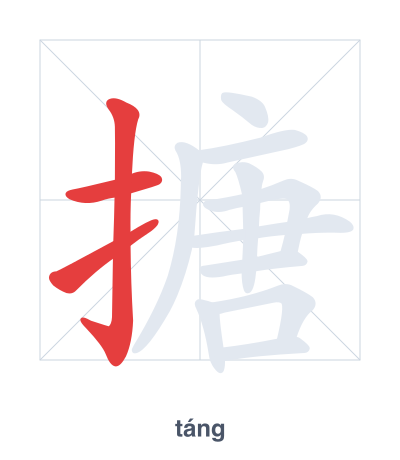
Open Hanzi Writer to see the animated stroke order and practice writing 搪 with real-time feedback.
The character 搪 (táng) is written with 13 strokes. Follow the standard Chinese stroke order: top to bottom, left to right, outside before inside. The radical 扌 is one of its key components.
Practice the correct stroke order with the Hanzi Writer app to see animated stroke-by-stroke guidance with real-time feedback.
搪 means to ward off or coat.
The left radical 扌 (hand) shows this is an action, while the right component 唐 (táng) provides phonetic value and originally depicted a large shelter or bell; together they suggest using the hand to shield or smear a coating.
💡 Memory Tip: Picture a hand (扌) slapping a thick coating of mud onto a giant mouth (口 under 广) to ward off a flood.
他在搪塞我。
tā zài táng sè wǒ
He is stalling me.
这是一个搪瓷杯。
zhè shì yí gè táng cí bēi
This is an enamel cup.
用手搪住门。
yòng shǒu táng zhù mén
Hold the door with your hand.
Open Hanzi Writer to see the animated stroke order and practice writing 搪 with real-time feedback.
✨ Animated stroke order · Handwriting recognition · HSK-graded practice · Free to use
The character 搪 is made of the radical 扌 (hand) on the left and the phonetic component 唐 (táng) on the right. The hand radical suggests an action, which connects to the meanings of using the hand to ward off or to apply a coating. 唐 provides pronunciation and does not contribute directly to the meaning.