郯 (tán) means "Tan (an ancient place name or surname)" in Chinese. It has 10 strokes with the radical 阝.
Rated 3.9/5 in difficulty (challenging).
Appears in 3+ common words including 郯城 (tán chéng), 郯子 (tán zi), 郯国 (tán guó).
Due to its 10 strokes, Hanzi Writer's error detection shows 郯 requires focused practice — most learners need 10+ attempts for consistent accuracy.
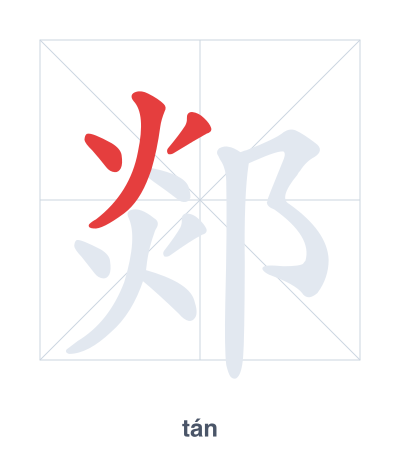
Open Hanzi Writer to see the animated stroke order and practice writing 郯 with real-time feedback.
The character 郯 (tán) is written with 10 strokes. Follow the standard Chinese stroke order: top to bottom, left to right, outside before inside. The radical 阝 is one of its key components.
Practice the correct stroke order with the Hanzi Writer app to see animated stroke-by-stroke guidance with real-time feedback.
郯 means Tan (an ancient place name or surname).
郯 is a compound character: the right radical 阝 (邑) means 'city' or 'state,' and the left component 炎 (yán, 'flame') acts as a phonetic hint. It refers to an ancient state or place name, located in present-day Shandong, and was also adopted as a surname.
💡 Memory Tip: Imagine a city (阝) where two towering flames (炎) mark the ancient capital of Tan, blazing with history.
郯城在山东省。
tán chéng zài shān dōng shěng
Tancheng is in Shandong Province.
郯子是一个古代名人。
tán zi shì yí gè gǔ dài míng rén
Tanzi is a famous person from ancient times.
郯国是古代的一个小国。
tán guó shì gǔ dài de yí gè xiǎo guó
The State of Tan was a small ancient state.
Open Hanzi Writer to see the animated stroke order and practice writing 郯 with real-time feedback.
✨ Animated stroke order · Handwriting recognition · HSK-graded practice · Free to use
郯 is made of two parts: the left component 阝 (which is the radical for 'place' or 'city') and the right component 炎 (meaning 'flame' or 'blazing'). The 阝 tells us the character relates to a place or state, and 炎 gives the pronunciation tán — together they form the name of an ancient state called 'Tan'.