肽 (tài) means "peptide" in Chinese. It has 8 strokes with the radical 月.
Rated 3.7/5 in difficulty (challenging).
Appears in 3+ common words including 多肽 (duō tài), 肽链 (tài liàn), 活性肽 (huó xìng tài).
Due to its 8 strokes, Hanzi Writer's error detection shows 肽 requires focused practice — most learners need 10+ attempts for consistent accuracy.
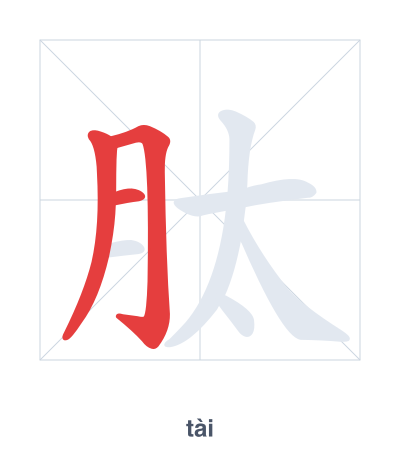
Open Hanzi Writer to see the animated stroke order and practice writing 肽 with real-time feedback.
The character 肽 (tài) is written with 8 strokes. Follow the standard Chinese stroke order: top to bottom, left to right, outside before inside. The radical 月 is one of its key components.
Practice the correct stroke order with the Hanzi Writer app to see animated stroke-by-stroke guidance with real-time feedback.
肽 means peptide.
肽 is a modern phono-semantic compound. The radical 月 (a variant of 肉, meaning 'flesh' or 'body') indicates its biological nature, while 太 (tài, meaning 'great' or 'extreme') provides the pronunciation and hints at the large molecule formed by many amino acids.
💡 Memory Tip: Picture a giant (太) slab of meat (月) being broken down into tiny peptide chains in a lab.
这种药含有多肽。
zhè zhǒng yào hán yǒu duō tài
This medicine contains polypeptides.
蛋白质由肽链组成。
dàn bái zhì yóu tài liàn zǔ chéng
Proteins are composed of peptide chains.
活性肽对身体有好处。
huó xìng tài duì shēn tǐ yǒu hǎo chù
Active peptides are good for the body.
Open Hanzi Writer to see the animated stroke order and practice writing 肽 with real-time feedback.
✨ Animated stroke order · Handwriting recognition · HSK-graded practice · Free to use
肽 has the radical 月 (meat/flesh) on the left, which links it to body proteins. The right side 太 (tài) gives the pronunciation and hints at the idea of a "big" or basic unit, as peptides are building blocks of proteins.