娑 (suō) means "to whirl" in Chinese. It has 10 strokes with the radical 女.
Rated 4.2/5 in difficulty (advanced).
Appears in 3+ common words including 婆娑 (pó suō), 娑婆 (suō pó), 摩娑 (mó suō).
Due to its 10 strokes, Hanzi Writer's error detection shows 娑 requires focused practice — most learners need 10+ attempts for consistent accuracy.
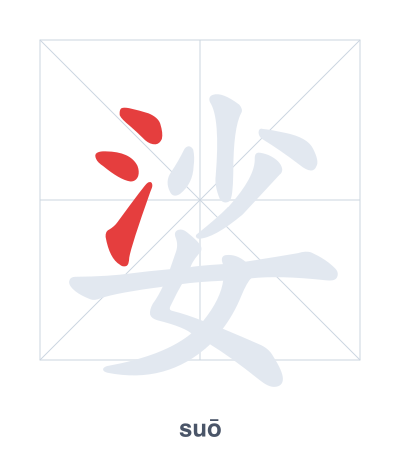
Open Hanzi Writer to see the animated stroke order and practice writing 娑 with real-time feedback.
The character 娑 (suō) is written with 10 strokes. Follow the standard Chinese stroke order: top to bottom, left to right, outside before inside. The radical 女 is one of its key components.
Practice the correct stroke order with the Hanzi Writer app to see animated stroke-by-stroke guidance with real-time feedback.
娑 means to whirl.
娑 is a compound character with the radical 女 (woman) and the phonetic component 沙 (shā, meaning sand). The combination suggests a woman moving in a swirling, whirling motion, like sand caught in a dance—capturing the sense of spinning or dancing gracefully.
💡 Memory Tip: Picture a woman (女) twirling so fast that sand (沙) whirls up around her in a dusty spiral.
树影在月下婆娑。
shù yǐng zài yuè xià pó suō
The tree shadows are dancing under the moonlight.
这是一个娑婆世界。
zhè shì yí gè suō pó shì jiè
This is a Sahā world (the world of suffering).
他轻轻摩娑着旧书。
tā qīng qīng mó suō zhe jiù shū
He gently stroked the old book.
Open Hanzi Writer to see the animated stroke order and practice writing 娑 with real-time feedback.
✨ Animated stroke order · Handwriting recognition · HSK-graded practice · Free to use
娑 combines the radical 女 (woman) on the left with 沙 (sand) on the right. The woman radical suggests graceful movement or dance, while the sand component evokes swirling motion, together hinting at the character's meaning of 'to whirl' or 'dance'.