锼 (sōu) means "To cut with a fret saw; to engrave" in Chinese. It has 14 strokes with the radical 钅.
Rated 4.2/5 in difficulty (advanced).
Appears in 3+ common words including 锼刻 (sōu kè), 锼花 (sōu huā), 锼一下 (sōu yī xià).
Due to its 14 strokes, Hanzi Writer's error detection shows 锼 requires focused practice — most learners need 10+ attempts for consistent accuracy.
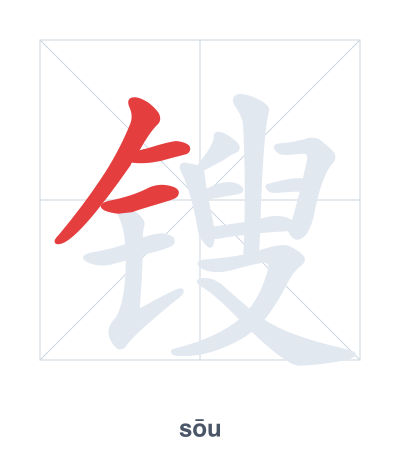
Open Hanzi Writer to see the animated stroke order and practice writing 锼 with real-time feedback.
The character 锼 (sōu) is written with 14 strokes. Follow the standard Chinese stroke order: top to bottom, left to right, outside before inside. The radical 钅 is one of its key components.
Practice the correct stroke order with the Hanzi Writer app to see animated stroke-by-stroke guidance with real-time feedback.
锼 means To cut with a fret saw; to engrave.
锼 is a phono-semantic compound: the radical 钅 (metal, gold) indicates its connection to cutting or engraving tools, while 叟 (sōu, meaning an old man) provides the pronunciation hint.
💡 Memory Tip: Imagine a wise old man (叟) slowly and skillfully cutting a delicate pattern into a metal (钅) plate with a tiny fret saw.
木头上锼刻着花纹。
mù tou shàng sōu kè zhe huā wén
Patterns are carved on the wood.
这种锼花工艺很复杂。
zhè zhǒng sōu huā gōng yì hěn fù zá
This fretwork craft is very complex.
把这个边缘锼一下。
bǎ zhè ge biān yuán sōu yī xià
Saw the edge with a fret saw.
Open Hanzi Writer to see the animated stroke order and practice writing 锼 with real-time feedback.
✨ Animated stroke order · Handwriting recognition · HSK-graded practice · Free to use
锼 is made of two parts: the left side 钅 (metal radical) and the right side 叟 (old man). The metal radical tells you it involves a metal tool, like a saw, while the right side 叟 gives the pronunciation sōu. Together they mean cutting or engraving with a saw-like tool.