螋 (sōu) means "Earwig" in Chinese. It has 15 strokes with the radical 虫.
Rated 4.2/5 in difficulty (advanced).
Appears in 3+ common words including 蠼螋 (qú sōu), 小螋 (xiǎo sōu), 这种螋 (zhè zhǒng sōu).
Due to its 15 strokes, Hanzi Writer's error detection shows 螋 requires focused practice — most learners need 10+ attempts for consistent accuracy.
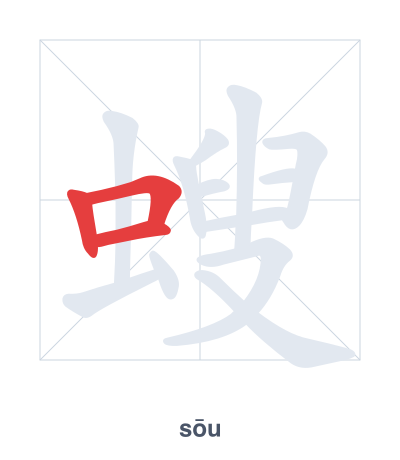
Open Hanzi Writer to see the animated stroke order and practice writing 螋 with real-time feedback.
The character 螋 (sōu) is written with 15 strokes. Follow the standard Chinese stroke order: top to bottom, left to right, outside before inside. The radical 虫 is one of its key components.
Practice the correct stroke order with the Hanzi Writer app to see animated stroke-by-stroke guidance with real-time feedback.
螋 means Earwig.
螋 is a phonosemantic compound, combining the insect radical 虫 with 叟 (sǒu, 'old man') as a phonetic component. The radical indicates the character refers to a type of insect, specifically the earwig, while the phonetic 叟 contributes to the pronunciation 'sōu'.
💡 Memory Tip: Picture an old man (叟) with a giant insect (虫) crawling on his shoulder, its pincers pinching his ear — that's the earwig (螋).
蠼螋喜欢在土里。
qú sōu xǐ huān zài tǔ lǐ
Earwigs like to be in the soil.
墙角有一只小螋。
qiáng jiǎo yǒu yī zhī xiǎo sōu
There is a small earwig in the corner.
这种螋没有毒。
zhè zhǒng sōu méi yǒu dú
This earwig is not poisonous.
Open Hanzi Writer to see the animated stroke order and practice writing 螋 with real-time feedback.
✨ Animated stroke order · Handwriting recognition · HSK-graded practice · Free to use
螋 has the radical 虫 (insect) on the left and 叟 on the right. The radical 虫 shows that the character belongs to the insect category, while 叟 provides the pronunciation sōu. Together they create the specific insect name "earwig."