溲 (sōu) means "to urinate; to soak" in Chinese. It has 12 strokes with the radical 氵.
Rated 4.2/5 in difficulty (advanced).
Appears in 3+ common words including 溲便 (sōu biàn), 溲疏 (sōu shū), 溲溺 (sōu nì).
Due to its 12 strokes, Hanzi Writer's error detection shows 溲 requires focused practice — most learners need 10+ attempts for consistent accuracy.
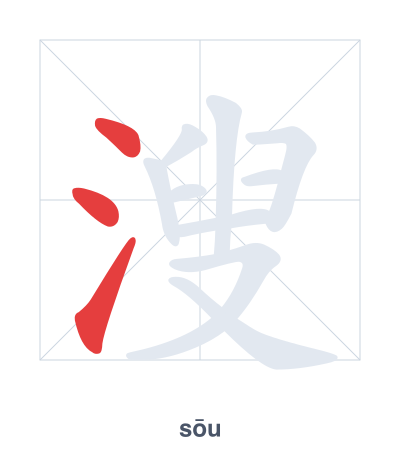
Open Hanzi Writer to see the animated stroke order and practice writing 溲 with real-time feedback.
The character 溲 (sōu) is written with 12 strokes. Follow the standard Chinese stroke order: top to bottom, left to right, outside before inside. The radical 氵 is one of its key components.
Practice the correct stroke order with the Hanzi Writer app to see animated stroke-by-stroke guidance with real-time feedback.
溲 means to urinate; to soak.
溲 combines the water radical 氵 with the phonetic component 叟 (sōu, meaning 'elderly man'). The water radical suggests liquid, while the whole character came to mean 'to urinate' or 'to soak', perhaps alluding to an elderly man's frequent need to urinate or the act of soaking something in water. The ancient form of 叟 shows a hand holding a torch, but here it functions primarily for sound.
💡 Memory Tip: Picture an old man (叟) by the water (氵) who can't hold it any longer and urgently urinates into the stream.
医生检查溲便。
yī shēng jiǎn chá sōu biàn
The doctor examined the urine and stool.
溲疏是一种植物。
sōu shū shì yī zhǒng zhí wù
Deutzia is a type of plant.
溲溺不通。
sōu nì bù tōng
Difficulty in urination.
Open Hanzi Writer to see the animated stroke order and practice writing 溲 with real-time feedback.
✨ Animated stroke order · Handwriting recognition · HSK-graded practice · Free to use
溲 is made of two parts: the left radical 氵 (water) and the right part 叟 (pronounced sǒu, meaning old man). The water radical connects to the idea of liquid, and 叟 gives the pronunciation. Together they create the meanings "to urinate" (a body liquid) and "to soak" (to put something in water).