溺 (nì) means "to drown; to indulge" in Chinese. It has 13 strokes with the radical 氵.
Rated 4.2/5 in difficulty (advanced).
Appears in 3+ common words including 溺水 (nì shuǐ), 溺爱 (nì ài), 沉溺 (chén nì).
Due to its 13 strokes, Hanzi Writer's error detection shows 溺 requires focused practice — most learners need 10+ attempts for consistent accuracy.
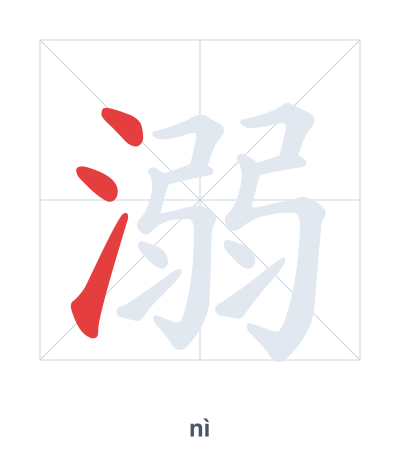
Open Hanzi Writer to see the animated stroke order and practice writing 溺 with real-time feedback.
The character 溺 (nì) is written with 13 strokes. Follow the standard Chinese stroke order: top to bottom, left to right, outside before inside. The radical 氵 is one of its key components.
Practice the correct stroke order with the Hanzi Writer app to see animated stroke-by-stroke guidance with real-time feedback.
溺 means to drown; to indulge.
溺 combines the water radical 氵 with 弱 (weak), depicting someone becoming weak or overwhelmed in water, leading to drowning. It later extended to mean 'to indulge,' like drowning in a vice.
💡 Memory Tip: Imagine a weak swimmer (弱) splashing helplessly in water (氵) as they start to drown.
游泳时要防止溺水。
yóu yǒng shí yào fáng zhǐ nì shuǐ
Prevent drowning while swimming.
父母不能溺爱孩子。
fù mǔ bù néng nì ài hái zi
Parents should not spoil their children.
不要沉溺于手机游戏。
bú yào chén nì yú shǒu jī yóu xì
Don't get addicted to mobile games.
Open Hanzi Writer to see the animated stroke order and practice writing 溺 with real-time feedback.
✨ Animated stroke order · Handwriting recognition · HSK-graded practice · Free to use
溺 is made of the water radical 氵 on the left and 弱 (ruò, weak) on the right. The water radical suggests the idea of water, while 弱 implies weakness or being overpowered. Together, they mean to drown in water or to be overwhelmed by indulgence.