澌 (sī) means "to drain or exhaust; ice floe" in Chinese. It has 15 strokes with the radical 氵.
Rated 4.2/5 in difficulty (advanced).
Appears in 3+ common words including 澌灭 (sī miè), 冰澌 (bīng sī), 澌尽 (sī jǐn).
Due to its 15 strokes, Hanzi Writer's error detection shows 澌 requires focused practice — most learners need 10+ attempts for consistent accuracy.
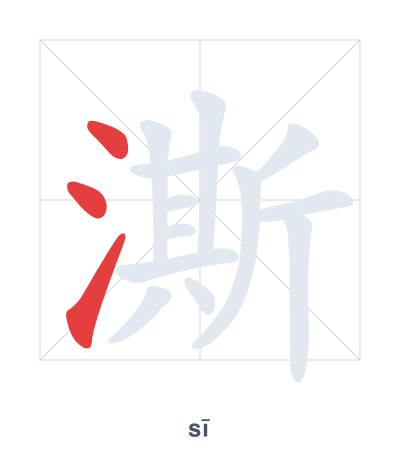
Open Hanzi Writer to see the animated stroke order and practice writing 澌 with real-time feedback.
The character 澌 (sī) is written with 15 strokes. Follow the standard Chinese stroke order: top to bottom, left to right, outside before inside. The radical 氵 is one of its key components.
Practice the correct stroke order with the Hanzi Writer app to see animated stroke-by-stroke guidance with real-time feedback.
澌 means to drain or exhaust; ice floe.
澌 combines the water radical (氵) with 斯 (sī, meaning 'to split'), evoking water splitting apart—like ice breaking into floes or water draining away until exhausted.
💡 Memory Tip: Imagine a river (氵) where a saw (斤) slices a block of ice (其) into floes that melt and drain away.
他的希望澌灭了。
tā de xī wàng sī miè le
His hopes have vanished.
河面上漂着冰澌。
hé miàn shàng piāo zhe bīng sī
Ice slush is floating on the river surface.
痛苦已经澌尽了。
tòng kǔ yǐ jīng sī jǐn le
The pain has completely vanished.
Open Hanzi Writer to see the animated stroke order and practice writing 澌 with real-time feedback.
✨ Animated stroke order · Handwriting recognition · HSK-graded practice · Free to use
澌 is made of the water radical 氵 on the left and the character 斯 on the right. The water radical hints at flowing water or ice, while 斯 contributes the sound and also suggests splitting or exhausting, together creating meanings like 'to drain away' or 'floating ice.'