漱 (shù) means "to rinse / to gargle" in Chinese. It has 14 strokes with the radical 氵.
Rated 4.2/5 in difficulty (advanced).
Appears in 3+ common words including 漱口 (shù kǒu), 洗漱 (xǐ shù), 漱口水 (shù kǒu shuǐ).
Due to its 14 strokes, Hanzi Writer's error detection shows 漱 requires focused practice — most learners need 10+ attempts for consistent accuracy.
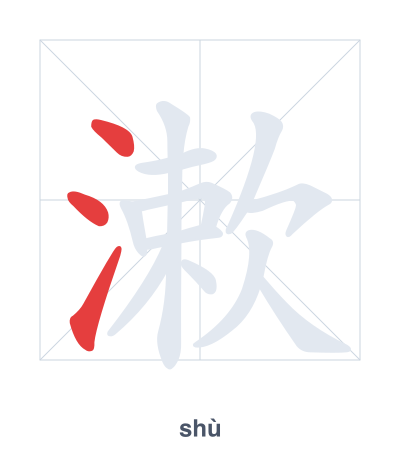
Open Hanzi Writer to see the animated stroke order and practice writing 漱 with real-time feedback.
The character 漱 (shù) is written with 14 strokes. Follow the standard Chinese stroke order: top to bottom, left to right, outside before inside. The radical 氵 is one of its key components.
Practice the correct stroke order with the Hanzi Writer app to see animated stroke-by-stroke guidance with real-time feedback.
漱 means to rinse / to gargle.
漱 combines the water radical 氵 (river, liquid) with 欶 (shuò), a component formed by 束 (bundle) and 欠 (open mouth) that hints at the action of opening the mouth to rinse. The character originally depicted the act of rinsing the mouth with water, as in ancient Chinese hygiene practices.
💡 Memory Tip: Imagine opening your mouth (欠) to gargle water (氵) while holding a bundle of herbs (束) as a natural mouthwash.
饭后要漱口。
fàn hòu yào shù kǒu
Rinse your mouth after meals.
我正在洗漱。
wǒ zhèng zài xǐ shù
I am washing up.
请用漱口水。
qǐng yòng shù kǒu shuǐ
Please use mouthwash.
Open Hanzi Writer to see the animated stroke order and practice writing 漱 with real-time feedback.
✨ Animated stroke order · Handwriting recognition · HSK-graded practice · Free to use
漱 is made of the water radical 氵 on the left and the phonetic component 欶 on the right. The water radical hints at the action involving liquid, like rinsing or gargling. The right part 欶 provides the pronunciation shù but also carries a sense of "sucking" or "drawing in," which fits the motion of swishing water in the mouth.