橾 (shū) means "axle hole; hub hole" in Chinese. It has 17 strokes with the radical 木.
Rated 4.2/5 in difficulty (advanced).
Appears in 3+ common words including 橾毂 (shū gǔ), 橾轴 (shū zhóu), 橾孔 (shū kǒng).
Due to its 17 strokes, Hanzi Writer's error detection shows 橾 requires focused practice — most learners need 10+ attempts for consistent accuracy.
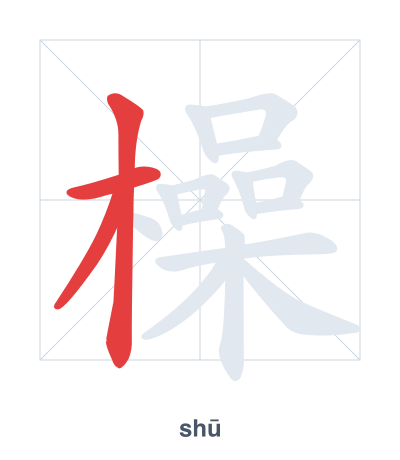
Open Hanzi Writer to see the animated stroke order and practice writing 橾 with real-time feedback.
The character 橾 (shū) is written with 17 strokes. Follow the standard Chinese stroke order: top to bottom, left to right, outside before inside. The radical 木 is one of its key components.
Practice the correct stroke order with the Hanzi Writer app to see animated stroke-by-stroke guidance with real-time feedback.
橾 means axle hole; hub hole.
橾 is a compound character: 木 (wood, the material of the hub) plus 喿 (phonetic, originally meaning 'chirping' but here only lending sound). It depicts the hole in the center of a wooden wheel hub where the axle fits, often greased to reduce squeaking noise.
💡 Memory Tip: Picture a wooden wheel hub (木) with three squeaky birds (three 口 in 喿) peeping out of the center hole—shū sounds like 'shoe,' and the axle slides into that hole like a foot into a shoe.
橾毂是车轮的一部分。
shū gǔ shì chē lún de yī bù fèn
The hub is a part of the wheel.
橾轴需要涂油。
shū zhóu xū yào tú yóu
The axle needs to be oiled.
橾孔里有很多灰。
shū kǒng lǐ yǒu hěn duō huī
There is a lot of dust in the axle hole.
Open Hanzi Writer to see the animated stroke order and practice writing 橾 with real-time feedback.
✨ Animated stroke order · Handwriting recognition · HSK-graded practice · Free to use
橾 is composed of the radical 木 (tree/wood) on the left and the phonetic component 喿 (zào) on the right. Since wooden wheels and axles were traditionally made from wood, the 木 radical connects to the character's meaning of axle hole or hub hole. The right side 喿 provides a pronunciation clue but does not directly contribute to the meaning.