枢 (shū) means "pivot; hub; center" in Chinese. It has 8 strokes with the radical 木, and is HSK Level 7.
Rated 3.7/5 in difficulty (challenging).
Harder than 27% of HSK Level 7 characters.
Appears in 3+ common words including 枢纽 (shū niǔ), 中枢 (zhōng shū), 枢纽站 (shū niǔ zhàn).
Due to its 8 strokes, Hanzi Writer's error detection shows 枢 requires focused practice — most learners need 10+ attempts for consistent accuracy.
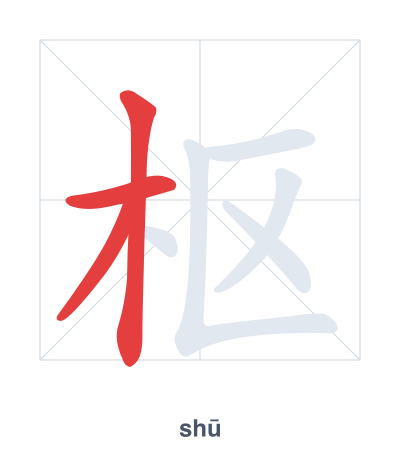
Open Hanzi Writer to see the animated stroke order and practice writing 枢 with real-time feedback.
The character 枢 (shū) is written with 8 strokes. Follow the standard Chinese stroke order: top to bottom, left to right, outside before inside. The radical 木 is one of its key components.
Practice the correct stroke order with the Hanzi Writer app to see animated stroke-by-stroke guidance with real-time feedback.
枢 means pivot; hub; center.
As an HSK Level 7 character, 枢 is an intermediate-level character.
枢 combines the radical 木 (wood) with 区 (area, district). The original meaning was the wooden pivot of a door—the central point around which the door turns, hence 'pivot' or 'hub'.
💡 Memory Tip: Picture a wooden (木) door hinge with a giant letter 'Q' (区) as the pivot point, spinning everything around it.
这里是交通枢纽。
zhè lǐ shì jiāo tōng shū niǔ
This is a transportation hub.
这是神经中枢。
zhè shì shén jīng zhōng shū
This is the nerve center.
我们在枢纽站换车。
wǒ men zài shū niǔ zhàn huàn chē
We change buses at the hub station.
Open Hanzi Writer to see the animated stroke order and practice writing 枢 with real-time feedback.
✨ Animated stroke order · Handwriting recognition · HSK-graded practice · Free to use
枢 is composed of the radical 木 (wood) on the left and the phonetic component 区 (qū) on the right. The wood radical suggests something made of wood, while 区 (area/region) hints at a central point in an area, together forming the idea of a pivot or hub. This structure aligns with 枢's meaning as a central axis or vital point.