狩 (shòu) means "to hunt" in Chinese. It has 9 strokes with the radical 犭.
Rated 4/5 in difficulty (challenging).
Appears in 3+ common words including 狩猎 (shòu liè), 狩猎季 (shòu liè jì), 巡狩 (xún shòu).
Due to its 9 strokes, Hanzi Writer's error detection shows 狩 requires focused practice — most learners need 10+ attempts for consistent accuracy.
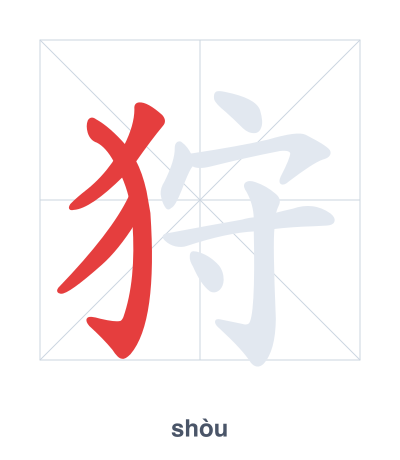
Open Hanzi Writer to see the animated stroke order and practice writing 狩 with real-time feedback.
The character 狩 (shòu) is written with 9 strokes. Follow the standard Chinese stroke order: top to bottom, left to right, outside before inside. The radical 犭 is one of its key components.
Practice the correct stroke order with the Hanzi Writer app to see animated stroke-by-stroke guidance with real-time feedback.
狩 means to hunt.
狩 combines the dog radical 犭 (a pictograph of a hound with curved body) with 守 (guard, watch), suggesting a dog that watches or tracks prey during a hunt. In ancient script, the left side depicted a sniffing dog, emphasizing the role of canine hunters.
💡 Memory Tip: Picture a dog (犭) on guard (守), ready to spring into action—it's a hunting dog waiting for the hunt to begin.
他们在森林里狩猎。
tā men zài sēn lín lǐ shòu liè
They are hunting in the forest.
现在是合法的狩猎季。
xiàn zài shì hé fǎ de shòu liè jì
It is now the legal hunting season.
古代皇帝常去巡狩。
gǔ dài huáng dì cháng qù xún shòu
Ancient emperors often went on inspection tours.
Open Hanzi Writer to see the animated stroke order and practice writing 狩 with real-time feedback.
✨ Animated stroke order · Handwriting recognition · HSK-graded practice · Free to use
The character 狩 combines the radical 犭 (dog) on the left and 守 (to guard) on the right. The dog radical connects to hunting, and 守 suggests waiting or watching, together meaning to hunt by stalking or guarding prey.