Hanzi Writer

How to Write 甥 (shēng) — Meaning “Nephew (sister's son)”

shēng 12 strokes Radical: 生

甥 (shēng) means "Nephew (sister's son)" in Chinese. It has 12 strokes with the radical 生.

Rated 4.2/5 in difficulty (advanced).

Appears in 3+ common words including 外甥 (wài shēng), 甥女 (shēng nǚ), 甥舅 (shēng jiù).

Due to its 12 strokes, Hanzi Writer's error detection shows 甥 requires focused practice — most learners need 10+ attempts for consistent accuracy.
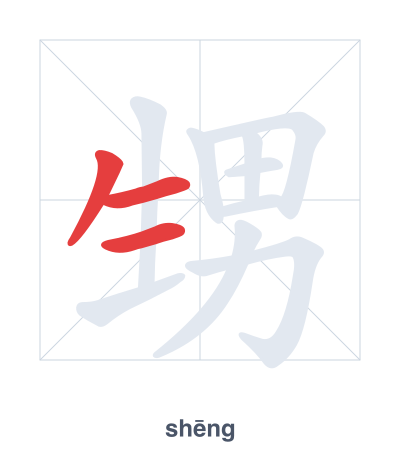
Stroke order practice for 甥 - shēng

Practice Writing 甥 (shēng)

Open Hanzi Writer to see the animated stroke order and practice writing 甥 with real-time feedback.

The character (shēng) is written with 12 strokes. Follow the standard Chinese stroke order: top to bottom, left to right, outside before inside. The radical is one of its key components.

Practice the correct stroke order with the Hanzi Writer app to see animated stroke-by-stroke guidance with real-time feedback.

means Nephew (sister's son).

Character
Pinyinshēng (sheng)
MeaningNephew (sister's son)
Strokes12
Radical
Difficulty4.2/5

甥 combines 生 (birth, also phonetic) with 男 (male) to mean 'male born from one's sister' — it's a phono-semantic compound where 生 provides the sound and 男 clarifies the gender and family relation.

💡 Memory Tip: Picture a baby boy (男) just born (生) from your sister, and you say, 'That's my 甥 (nephew)!'

wài shēng
sister's son / nephew
shēng nǚ
Niece (sister's daughter)
shēng jiù
Nephew and uncle

我的外甥很聪明。

wǒ de wài shēng hěn cōng míng

My nephew is very smart.

他的甥女在上海。

tā de shēng nǚ zài shàng hǎi

His niece is in Shanghai.

他们是甥舅关系。

tā men shì shēng jiù guān xì

They are nephew and uncle.

Character Pinyin Strokes Radical
(current) shēng 12
ruí 12
Stroke order practice for 甥 - shēng

Practice Writing 甥 (shēng)

Open Hanzi Writer to see the animated stroke order and practice writing 甥 with real-time feedback.

✨ Animated stroke order · Handwriting recognition · HSK-graded practice · Free to use

Frequently Asked Questions about 甥

The character 甥 is a top-bottom structure combining 生 (birth) and 男 (male). Together they suggest a male child born from one's sister, which is the meaning of 'nephew (sister's son).'

Characters with Radical 生

Other 12-Stroke Characters