汕 (shàn) means "Shantou (Swatow) / a type of fish trap" in Chinese. It has 6 strokes with the radical 氵.
Rated 3.2/5 in difficulty (challenging).
Appears in 3+ common words including 汕头 (shàn tóu), 汕尾 (shàn wěi), 汕头话 (shàn tóu huà).
Due to its 6 strokes, Hanzi Writer's error detection shows 汕 requires focused practice — most learners need 10+ attempts for consistent accuracy.
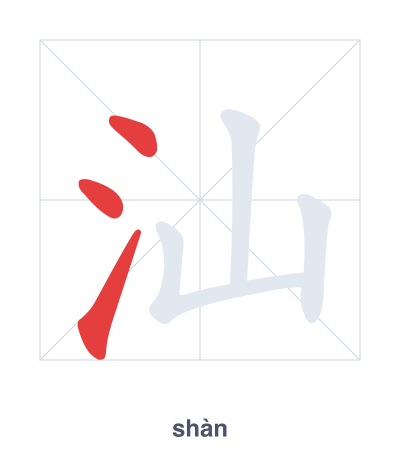
Open Hanzi Writer to see the animated stroke order and practice writing 汕 with real-time feedback.
The character 汕 (shàn) is written with 6 strokes. Follow the standard Chinese stroke order: top to bottom, left to right, outside before inside. The radical 氵 is one of its key components.
Practice the correct stroke order with the Hanzi Writer app to see animated stroke-by-stroke guidance with real-time feedback.
汕 means Shantou (Swatow) / a type of fish trap.
汕 combines the water radical 氵 (river/sea) with 山 (mountain), depicting a place where mountains meet water — originally referring to a river name in ancient China, later used for the coastal city Shantou. The fish trap meaning likely derives from a net or weir placed in such a mountain-stream environment, where water flows around a barrier shaped like a hill.
💡 Memory Tip: Imagine a mountain (山) rising from the sea (氵) with a woven fish trap clinging to its slope, catching fish where the waves and shore meet.
我去过汕头。
wǒ qù guò shàn tóu
I have been to Shantou.
汕尾在广东。
shàn wěi zài guǎng dōng
Shanwei is in Guangdong.
他会说汕头话。
tā huì shuō shàn tóu huà
He can speak the Shantou dialect.
Open Hanzi Writer to see the animated stroke order and practice writing 汕 with real-time feedback.
✨ Animated stroke order · Handwriting recognition · HSK-graded practice · Free to use
汕 is made of the water radical 氵 on the left and 山 (mountain) on the right. The water radical connects to its meanings: Shantou is a coastal city (water by a mountain), and a fish trap (something placed in water). The mountain part provides the pronunciation "shàn" and gives a visual hint to the place name 汕头 (Shantou means "mountain head").