莎 (shā/suō) means "Sedge (a type of grass)" in Chinese. It has 10 strokes with the radical 艹.
Rated 4.2/5 in difficulty (advanced).
Appears in 3+ common words including 莎士比亚 (shā shì bǐ yà), 莎莎 (shā shā), 莎草 (suō cǎo).
Due to its 10 strokes, Hanzi Writer's error detection shows 莎 requires focused practice — most learners need 10+ attempts for consistent accuracy.
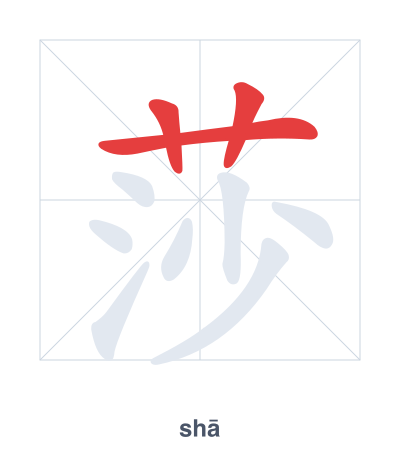
Open Hanzi Writer to see the animated stroke order and practice writing 莎 with real-time feedback.
The character 莎 (shā/suō) is written with 10 strokes. Follow the standard Chinese stroke order: top to bottom, left to right, outside before inside. The radical 艹 is one of its key components.
Practice the correct stroke order with the Hanzi Writer app to see animated stroke-by-stroke guidance with real-time feedback.
莎 means Sedge (a type of grass).
This is a polyphonic character with readings: shā, suō.
莎 is a phono-semantic compound: the radical 艹 indicates 'grass', while 沙 (shā, 'sand') provides the pronunciation. This sedge grass often grows in sandy or marshy areas, linking the components visually and ecologically.
💡 Memory Tip: Imagine a sedge plant sprouting from a sandy beach (沙) with its tall grass blades (艹) waving like little green flags.
莎士比亚是伟大的作家。
shā shì bǐ yà shì wěi dà de zuò jiā
Shakespeare is a great writer.
树叶发出莎莎的响声。
shù yè fā chū shā shā de xiǎng shēng
The leaves are making a rustling sound.
河边长着许多莎草。
hé biān zhǎng zhe xǔ duō suō cǎo
Many sedges are growing by the river.
Open Hanzi Writer to see the animated stroke order and practice writing 莎 with real-time feedback.
✨ Animated stroke order · Handwriting recognition · HSK-graded practice · Free to use
The character 莎 consists of the radical 艹 (grass) on top and 沙 (shā, sand) underneath. The grass radical shows that the character relates to plants, while 沙 provides the pronunciation and hints at the plant growing in sandy soil. Together, they form the meaning 'sedge,' a type of grass that often grows near water or in damp sand.