糁 (sǎn) means "Grits" in Chinese. It has 14 strokes with the radical 米.
Rated 4.2/5 in difficulty (advanced).
Appears in 3+ common words including 糁子 (sǎn zi), 饭糁 (fàn sǎn), 糁汤 (sǎn tāng).
Due to its 14 strokes, Hanzi Writer's error detection shows 糁 requires focused practice — most learners need 10+ attempts for consistent accuracy.
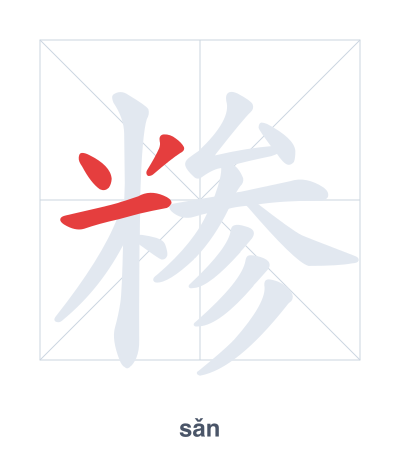
Open Hanzi Writer to see the animated stroke order and practice writing 糁 with real-time feedback.
The character 糁 (sǎn) is written with 14 strokes. Follow the standard Chinese stroke order: top to bottom, left to right, outside before inside. The radical 米 is one of its key components.
Practice the correct stroke order with the Hanzi Writer app to see animated stroke-by-stroke guidance with real-time feedback.
糁 means Grits.
糁 is a semantic-phonetic compound: the left radical 米 (rice/grain) indicates the meaning of coarsely ground grain, while the right component 参 (sǎn, also meaning 'to mix' or 'participate') provides the sound and suggests the mixing process that creates grits.
💡 Memory Tip: Picture a bowl of rice (米) that has been 'participated' (参) by a grinder, breaking into coarse grits scattered around.
锅里有玉米糁子。
guō lǐ yǒu yù mǐ sǎn zi
There are corn grits in the pot.
衣服上沾了饭糁。
yī fú shàng zhān le fàn sǎn
There are grains of rice stuck on the clothes.
这种糁汤很好喝。
zhè zhǒng sǎn tāng hěn hǎo hē
This grain soup is very tasty.
Open Hanzi Writer to see the animated stroke order and practice writing 糁 with real-time feedback.
✨ Animated stroke order · Handwriting recognition · HSK-graded practice · Free to use
糁 is made of the radical 米 (rice) on the left and 参 (shēn, meaning "participate") on the right. The rice radical connects the character to grains and food, while 参 suggests the idea of mixing or adding together, forming the meaning of crushed or broken grains like grits.