洳 (rù) means "Damp; marshy (often used in river names)" in Chinese. It has 9 strokes with the radical 氵.
Rated 4/5 in difficulty (challenging).
Appears in 3+ common words including 洳河 (rù hé), 沮洳 (jù rù), 洳水 (rù shuǐ).
Due to its 9 strokes, Hanzi Writer's error detection shows 洳 requires focused practice — most learners need 10+ attempts for consistent accuracy.
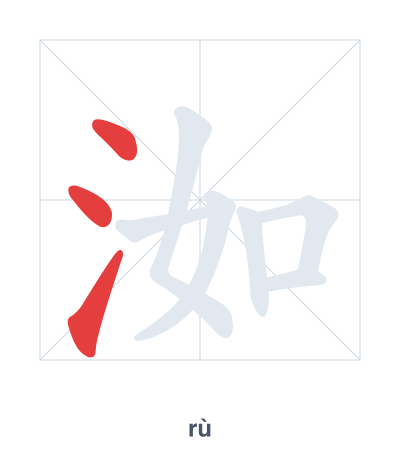
Open Hanzi Writer to see the animated stroke order and practice writing 洳 with real-time feedback.
The character 洳 (rù) is written with 9 strokes. Follow the standard Chinese stroke order: top to bottom, left to right, outside before inside. The radical 氵 is one of its key components.
Practice the correct stroke order with the Hanzi Writer app to see animated stroke-by-stroke guidance with real-time feedback.
洳 means Damp; marshy (often used in river names).
洳 is a phono-semantic compound: the left side '氵' (water) indicates its meaning of dampness or marsh, while the right side '如' (rú) provides the sound. The character is commonly used in Chinese river names to describe marshy or soggy terrain, combining the idea of water with a phonetic hint.
💡 Memory Tip: Imagine a woman (女) opening her mouth (口) in a swamp, saying 'Ru' as she steps into the damp, muddy water.
这是一条叫洳河的河。
zhè shì yī tiáo jiào rù hé de hé
This is a river called the Ru River.
这里的地方很沮洳。
zhè lǐ de dì fāng hěn jù rù
This place is marshy and damp.
洳水在北方。
rù shuǐ zài běi fāng
The Ru River is in the north.
Open Hanzi Writer to see the animated stroke order and practice writing 洳 with real-time feedback.
✨ Animated stroke order · Handwriting recognition · HSK-graded practice · Free to use
洳 is made of two parts: the left radical 氵 (water) and the right part 如 (rù, which gives the sound). Since the meaning is "damp" or "marshy," the water radical connects directly to wet environments.