颥 (rú) means "Temple (of the head)" in Chinese. It has 20 strokes with the radical 页.
Rated 4.2/5 in difficulty (advanced).
Appears in 3+ common words including 颞颥 (niè rú), 颥骨 (rú gǔ), 颥穴 (rú xué).
Due to its 20 strokes, Hanzi Writer's error detection shows 颥 requires focused practice — most learners need 10+ attempts for consistent accuracy.
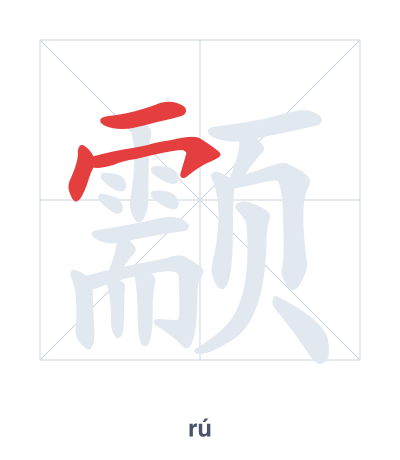
Open Hanzi Writer to see the animated stroke order and practice writing 颥 with real-time feedback.
The character 颥 (rú) is written with 20 strokes. Follow the standard Chinese stroke order: top to bottom, left to right, outside before inside. The radical 页 is one of its key components.
Practice the correct stroke order with the Hanzi Writer app to see animated stroke-by-stroke guidance with real-time feedback.
颥 means Temple (of the head).
颥 is a phono-semantic compound: the radical 页 (head) indicates the temple is a part of the head, while 需 (rú) provides the pronunciation. The character visually shows the head (页) with a phonetic component that sounds like 'need,' linking the temple as a sensitive spot on the skull.
💡 Memory Tip: Imagine your head (页) 'needs' (需) a gentle rub right on the temple to relieve a headache.
医生按了按他的颞颥。
yī shēng àn le àn tā de niè rú
The doctor pressed his temples.
这是人体的颥骨。
zhè shì rén tǐ de rú gǔ
This is the temporal bone of the human body.
按摩颥穴很舒服。
àn mó rú xué hěn shū fú
Massaging the temples feels very comfortable.
Open Hanzi Writer to see the animated stroke order and practice writing 颥 with real-time feedback.
✨ Animated stroke order · Handwriting recognition · HSK-graded practice · Free to use
颥 (rú) consists of the radical 页 (page/head) on the right and the phonetic component 需 (xū) on the left. The radical 页 indicates the character relates to the head, while 需 hints at the pronunciation rú — together they form 'temple of the head'.