狨 (róng) means "marmoset" in Chinese. It has 9 strokes with the radical 犭.
Rated 4/5 in difficulty (challenging).
Appears in 3+ common words including 狨猴 (róng hóu), 金狨 (jīn róng), 狨皮 (róng pí).
Due to its 9 strokes, Hanzi Writer's error detection shows 狨 requires focused practice — most learners need 10+ attempts for consistent accuracy.
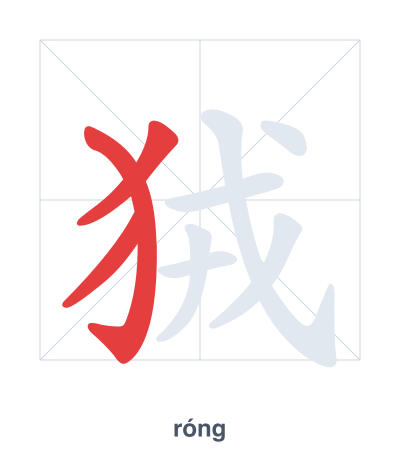
Open Hanzi Writer to see the animated stroke order and practice writing 狨 with real-time feedback.
The character 狨 (róng) is written with 9 strokes. Follow the standard Chinese stroke order: top to bottom, left to right, outside before inside. The radical 犭 is one of its key components.
Practice the correct stroke order with the Hanzi Writer app to see animated stroke-by-stroke guidance with real-time feedback.
狨 means marmoset.
狨 is a compound character combining the radical 犭 (animal) with 戎 (róng) as a phonetic component. The right part 戎 originally depicted a shield and halberd, representing warfare, but here it only provides pronunciation. Thus 狨 means a type of small monkey called a marmoset.
💡 Memory Tip: Imagine a tiny marmoset dressed in armor (戎) like a little warrior, holding a shield and spear while foraging in the jungle.
狨猴是一种很小的猴子。
róng hóu shì yī zhǒng hěn xiǎo de hóu zi
The marmoset is a very small monkey.
金狨的毛色很漂亮。
jīn róng de máo sè hěn piào liàng
The golden snub-nosed monkey has a very beautiful coat.
这种狨皮非常柔软。
zhè zhǒng róng pí fēi cháng róu ruǎn
This marmoset fur is very soft.
Open Hanzi Writer to see the animated stroke order and practice writing 狨 with real-time feedback.
✨ Animated stroke order · Handwriting recognition · HSK-graded practice · Free to use
The left radical 犭 indicates that the character relates to animals, specifically mammals. The right part 戎 (róng) gives the pronunciation and originally meant "weapon" or "military" but here acts purely as a phonetic component. Together, 狨 means "marmoset," a type of small monkey.