惓 (quán) means "Tired" in Chinese. It has 11 strokes with the radical 忄.
Rated 4.2/5 in difficulty (advanced).
Appears in 3+ common words including 惓惓 (quán quán), 厌惓 (yàn quán), 疲惓 (pí quán).
Due to its 11 strokes, Hanzi Writer's error detection shows 惓 requires focused practice — most learners need 10+ attempts for consistent accuracy.
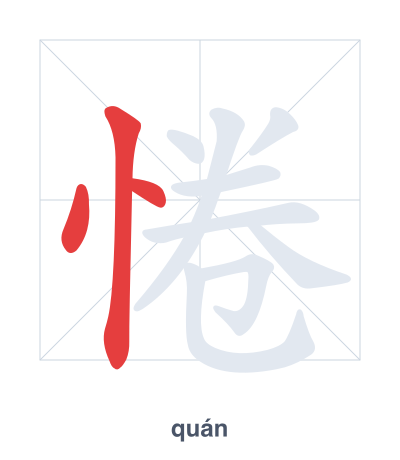
Open Hanzi Writer to see the animated stroke order and practice writing 惓 with real-time feedback.
The character 惓 (quán) is written with 11 strokes. Follow the standard Chinese stroke order: top to bottom, left to right, outside before inside. The radical 忄 is one of its key components.
Practice the correct stroke order with the Hanzi Writer app to see animated stroke-by-stroke guidance with real-time feedback.
惓 means Tired.
惓 combines the heart radical (忄) with 卷 (juàn, meaning 'roll' or 'scroll'). The heart being 'rolled up' suggests a feeling of being worn out or weary, as if one's energy has been curled away.
💡 Memory Tip: Imagine your heart (忄) getting so tired that it curls up like a rolled scroll (卷).
他表达了惓惓之意。
tā biǎo dá le quán quán zhī yì
He expressed his sincere intentions.
他对工作感到厌惓。
tā duì gōng zuò gǎn dào yàn quán
He feels weary of his work.
走了很久,他很疲惓。
zǒu le hěn jiǔ tā hěn pí quán
He was very tired after walking for a long time.
Open Hanzi Writer to see the animated stroke order and practice writing 惓 with real-time feedback.
✨ Animated stroke order · Handwriting recognition · HSK-graded practice · Free to use
惓 is made of two parts: the left side 忄 (heart radical) and the right side 卷 (quán, meaning to roll). The heart radical connects to feelings and emotions, so it indicates that tiredness is a state of the heart or mind. The right side 卷 gives the character its pronunciation but also suggests a feeling of being rolled up or worn out.