遒 (qiú) means "Strong / Powerful" in Chinese. It has 12 strokes with the radical 辶.
Rated 4.2/5 in difficulty (advanced).
Appears in 3+ common words including 遒劲 (qiú jìng), 遒丽 (qiú lì), 遒健 (qiú jiàn).
Due to its 12 strokes, Hanzi Writer's error detection shows 遒 requires focused practice — most learners need 10+ attempts for consistent accuracy.
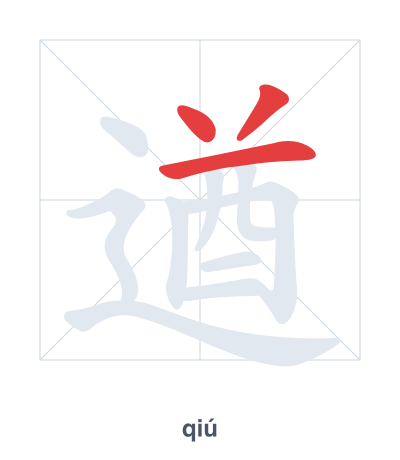
Open Hanzi Writer to see the animated stroke order and practice writing 遒 with real-time feedback.
The character 遒 (qiú) is written with 12 strokes. Follow the standard Chinese stroke order: top to bottom, left to right, outside before inside. The radical 辶 is one of its key components.
Practice the correct stroke order with the Hanzi Writer app to see animated stroke-by-stroke guidance with real-time feedback.
遒 means Strong / Powerful.
The character 遒 combines the radical 辶 (walking) with 酋 (chief), suggesting the forceful stride of a leader moving with power. In ancient contexts, 酋 referred to a tribal chief or fermented wine, and adding the walking radical implies pressing forward strongly or acting with vigor.
💡 Memory Tip: Picture a powerful chief (酋) striding forward (辶) with unstoppable strength.
他的书法非常遒劲。
tā de shū fǎ fēi cháng qiú jìng
His calligraphy is very powerful and vigorous.
这篇文章文笔遒丽。
zhè piān wén zhāng wén bǐ qiú lì
The writing style of this article is forceful and elegant.
他的舞姿很有力,很遒健。
tā de wǔ zī hěn yǒu lì hěn qiú jiàn
His dancing is powerful and vigorous.
Open Hanzi Writer to see the animated stroke order and practice writing 遒 with real-time feedback.
✨ Animated stroke order · Handwriting recognition · HSK-graded practice · Free to use
The character 遒 combines the radical 辶 (walk/action) with the component 酋 (qiú, meaning chief or strong). The 辶 suggests movement or force, while 酋 implies strength and leadership, together forming the idea of powerful or vigorous action.