岢 (kě) means "Ke (used in place names)" in Chinese. It has 8 strokes with the radical 山.
Rated 3.7/5 in difficulty (challenging).
Appears in 3+ common words including 岢岚 (kě lán), 岢岚县 (kě lán xiàn), 岢山 (kě shān).
Due to its 8 strokes, Hanzi Writer's error detection shows 岢 requires focused practice — most learners need 10+ attempts for consistent accuracy.
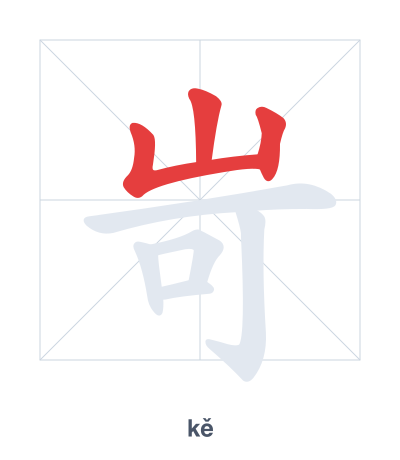
Open Hanzi Writer to see the animated stroke order and practice writing 岢 with real-time feedback.
The character 岢 (kě) is written with 8 strokes. Follow the standard Chinese stroke order: top to bottom, left to right, outside before inside. The radical 山 is one of its key components.
Practice the correct stroke order with the Hanzi Writer app to see animated stroke-by-stroke guidance with real-time feedback.
岢 means Ke (used in place names).
岢 is a phono-semantic compound where 山 (mountain) hints at the meaning—this character appears in mountain-related place names like 岢岚—and 可 (kě) provides the pronunciation. The combination simply pairs 'mountain' with a phonetic element to create a toponymic character.
💡 Memory Tip: Picture a mountain (山) with a giant sign that says 'Kě = OK' (可), marking the spot as the famous place name 岢.
岢岚是一个县城。
kě lán shì yí gè xiàn chéng
Kelan is a county town.
岢岚县在山西省。
kě lán xiàn zài shān xī shěng
Kelan County is in Shanxi Province.
岢山的山路很难走。
kě shān de shān lù hěn nán zǒu
The mountain roads of Keshan are very difficult to travel.
Open Hanzi Writer to see the animated stroke order and practice writing 岢 with real-time feedback.
✨ Animated stroke order · Handwriting recognition · HSK-graded practice · Free to use
岢 is formed by the radical 山 (mountain) on top and the character 可 (kě) below. The mountain radical indicates that the character is related to geography or mountains, and 可 provides the pronunciation. This structure is common for characters used in place names like 岢岚.