荞 (qiáo) means "Buckwheat" in Chinese. It has 9 strokes with the radical 艹.
Rated 4/5 in difficulty (challenging).
Appears in 3+ common words including 荞麦 (qiáo mài), 荞麦面 (qiáo mài miàn), 荞麦茶 (qiáo mài chá).
Due to its 9 strokes, Hanzi Writer's error detection shows 荞 requires focused practice — most learners need 10+ attempts for consistent accuracy.
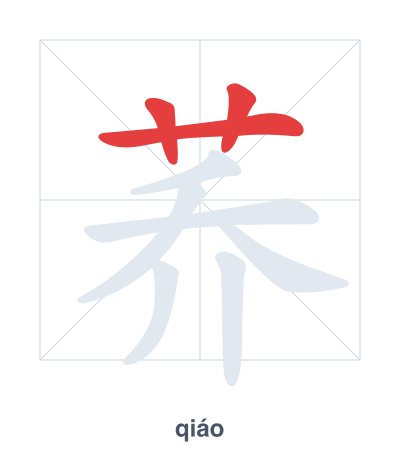
Open Hanzi Writer to see the animated stroke order and practice writing 荞 with real-time feedback.
The character 荞 (qiáo) is written with 9 strokes. Follow the standard Chinese stroke order: top to bottom, left to right, outside before inside. The radical 艹 is one of its key components.
Practice the correct stroke order with the Hanzi Writer app to see animated stroke-by-stroke guidance with real-time feedback.
荞 means Buckwheat.
荞 is a compound character with the grass radical 艹 indicating it is a plant, and 乔 (qiáo, meaning tall) serving as a phonetic component that also hints at buckwheat's relatively tall growth. Together, the character represents buckwheat, a plant known for its edible seeds.
💡 Memory Tip: Imagine a tall (乔) blade of grass (艹) topped with a cluster of triangular buckwheat seeds.
荞麦是一种健康的粗粮。
qiáo mài shì yī zhǒng jiàn kāng de cū liáng
Buckwheat is a healthy coarse grain.
我午饭想吃荞麦面。
wǒ wǔ fàn xiǎng chī qiáo mài miàn
I want to eat buckwheat noodles for lunch.
这种荞麦茶很好喝。
zhè zhǒng qiáo mài chá hěn hǎo hē
This buckwheat tea is very tasty.
Open Hanzi Writer to see the animated stroke order and practice writing 荞 with real-time feedback.
✨ Animated stroke order · Handwriting recognition · HSK-graded practice · Free to use
荞 is composed of the radical 艹 (grass, plant) on top and 乔 (qiáo, meaning tall or lofty) below. The grass radical shows that buckwheat is a plant, while 乔 provides the pronunciation hint. Together, they form the character for buckwheat, a tall grass-like plant.