硗 (qiāo) means "barren (soil)" in Chinese. It has 11 strokes with the radical 石.
Rated 4.2/5 in difficulty (advanced).
Appears in 3+ common words including 硗地 (qiāo dì), 硗薄 (qiāo báo), 硗瘠 (qiāo jí).
Due to its 11 strokes, Hanzi Writer's error detection shows 硗 requires focused practice — most learners need 10+ attempts for consistent accuracy.
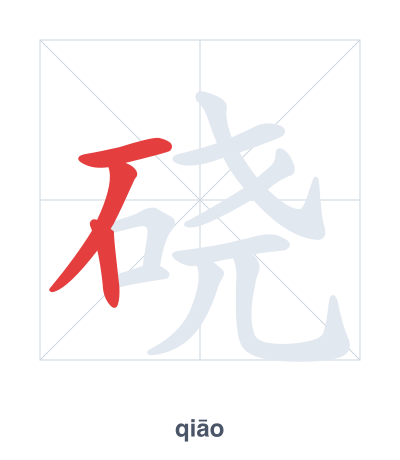
Open Hanzi Writer to see the animated stroke order and practice writing 硗 with real-time feedback.
The character 硗 (qiāo) is written with 11 strokes. Follow the standard Chinese stroke order: top to bottom, left to right, outside before inside. The radical 石 is one of its key components.
Practice the correct stroke order with the Hanzi Writer app to see animated stroke-by-stroke guidance with real-time feedback.
硗 means barren (soil).
硗 combines the radical 石 (stone) with 尧, which originally depicted a tall earthen mound. Together, they suggest soil so full of rocks and stones that it is hard, dry, and unable to support crops—hence 'barren.'
💡 Memory Tip: Picture a farmer striking the ground with a stone (石) only to find a tall, skull-like mound (尧) that yields nothing but dust—literally 'barren' soil.
硗地很难种菜。
qiāo dì hěn nán zhòng cài
It is hard to grow vegetables on barren land.
这里的土地很硗薄。
zhè lǐ de tǔ dì hěn qiāo báo
The land here is stony and infertile.
土地非常硗瘠。
tǔ dì fēi cháng qiāo jí
The land is very barren and infertile.
Open Hanzi Writer to see the animated stroke order and practice writing 硗 with real-time feedback.
✨ Animated stroke order · Handwriting recognition · HSK-graded practice · Free to use
硗 is composed of the radical 石 (stone) on the left and 尧 (yáo, meaning "high" or "lofty") on the right. The stone radical suggests hard, rocky ground, while 尧 hints at high or dry conditions, together conveying the idea of barren, unproductive soil.