碛 (qì) means "Rocks in a river / Sandy beach" in Chinese. It has 13 strokes with the radical 石.
Rated 4.2/5 in difficulty (advanced).
Appears in 3+ common words including 沙碛 (shā qì), 碛口 (qì kǒu), 滩碛 (tān qì).
Due to its 13 strokes, Hanzi Writer's error detection shows 碛 requires focused practice — most learners need 10+ attempts for consistent accuracy.
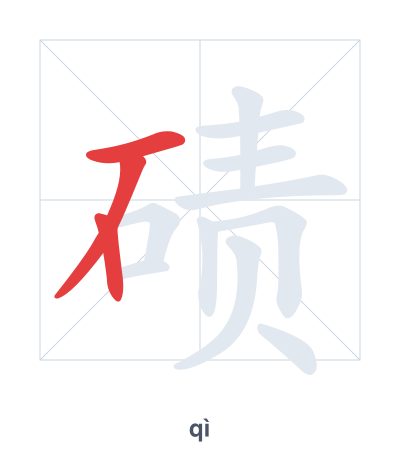
Open Hanzi Writer to see the animated stroke order and practice writing 碛 with real-time feedback.
The character 碛 (qì) is written with 13 strokes. Follow the standard Chinese stroke order: top to bottom, left to right, outside before inside. The radical 石 is one of its key components.
Practice the correct stroke order with the Hanzi Writer app to see animated stroke-by-stroke guidance with real-time feedback.
碛 means Rocks in a river / Sandy beach.
碛 is a phono-semantic compound where 石 (stone/rock) is the semantic radical indicating its relation to rocks, and 责 (zé) provides the pronunciation. The character describes rocks in a river or a sandy beach formed by water flowing over stones.
💡 Memory Tip: Picture a stone (石) that is 'charged' (责) with the duty of sitting in a river, creating a sandy beach as water flows around it.
沙漠里到处是沙碛。
shā mò lǐ dào chù shì shā qì
The desert is full of sand and gravel.
碛口是一个古老的镇子。
qì kǒu shì yí gè gǔ lǎo de zhèn zi
Qikou is an ancient town.
河边有很多滩碛。
hé biān yǒu hěn duō tān qì
There are many sandbars and shoals by the river.
Open Hanzi Writer to see the animated stroke order and practice writing 碛 with real-time feedback.
✨ Animated stroke order · Handwriting recognition · HSK-graded practice · Free to use
The character 碛 is made of the radical 石 (stone) on the left and the phonetic component 责 on the right. The left radical shows that the meaning relates to stone or rock, and the whole character refers to rocks or sand in a river or on a beach. 责 provides the sound "qì" but does not directly add meaning.