濮 (pú) means "Pu (river name)" in Chinese. It has 17 strokes with the radical 氵.
Rated 4.2/5 in difficulty (advanced).
Appears in 3+ common words including 濮阳 (pú yáng), 濮水 (pú shuǐ), 姓濮 (xìng pú).
Due to its 17 strokes, Hanzi Writer's error detection shows 濮 requires focused practice — most learners need 10+ attempts for consistent accuracy.
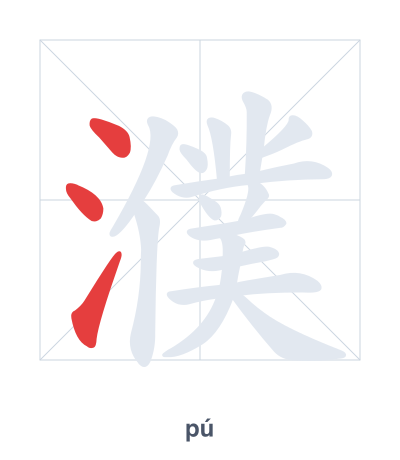
Open Hanzi Writer to see the animated stroke order and practice writing 濮 with real-time feedback.
The character 濮 (pú) is written with 17 strokes. Follow the standard Chinese stroke order: top to bottom, left to right, outside before inside. The radical 氵 is one of its key components.
Practice the correct stroke order with the Hanzi Writer app to see animated stroke-by-stroke guidance with real-time feedback.
濮 means Pu (river name).
濮 is a river name, combining the water radical (氵) with 僕 (pú, meaning 'servant' or 'attendant') as a phonetic component. The character's structure indicates a body of water (the river Pu) associated with the sound of 僕, without implying a literal servant in the water.
💡 Memory Tip: Picture a servant (僕) holding a bucket of water (氵) while standing in the Pu River, frantically trying to keep his uniform dry.
濮阳在河南省。
pú yáng zài hé nán shěng
Puyang is in Henan Province.
濮水流得很慢。
pú shuǐ liú dé hěn màn
The Pu River flows very slowly.
我的汉语老师姓濮。
wǒ de hàn yǔ lǎo shī xìng pú
My Chinese teacher's surname is Pu.
Open Hanzi Writer to see the animated stroke order and practice writing 濮 with real-time feedback.
✨ Animated stroke order · Handwriting recognition · HSK-graded practice · Free to use
濮 is composed of the radical 氵 (water) on the left, and the phonetic component 僕 (pú) on the right. The water radical indicates that the original meaning is a river name, while 僕 provides the pronunciation.