骈 (pián) means "Parallel; side by side" in Chinese. It has 9 strokes with the radical 马.
Rated 4/5 in difficulty (challenging).
Appears in 3+ common words including 骈文 (pián wén), 骈列 (pián liè), 骈体 (pián tǐ).
Due to its 9 strokes, Hanzi Writer's error detection shows 骈 requires focused practice — most learners need 10+ attempts for consistent accuracy.
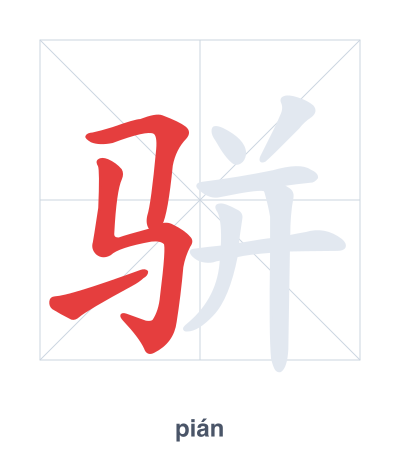
Open Hanzi Writer to see the animated stroke order and practice writing 骈 with real-time feedback.
The character 骈 (pián) is written with 9 strokes. Follow the standard Chinese stroke order: top to bottom, left to right, outside before inside. The radical 马 is one of its key components.
Practice the correct stroke order with the Hanzi Writer app to see animated stroke-by-stroke guidance with real-time feedback.
骈 means Parallel; side by side.
骈 is a compound character with the radical 马 (horse) and phonetic component 并 (bìng, meaning 'combine' or 'side by side'). The original meaning was 'a team of two horses hitched together,' from which the sense of 'parallel, side by side' derives.
💡 Memory Tip: Picture two horses (马) standing side by side, their bodies merging into the shape of 并—like a pair of parallel racers.
骈文讲究对仗工整。
pián wén jiǎng jiū duì zhàng gōng zhěng
Parallel prose emphasizes neat antithesis.
许多车辆骈列在路边。
xǔ duō chē liàng pián liè zài lù biān
Many vehicles are lined up by the roadside.
这种文章属于骈体。
zhè zhǒng wén zhāng shǔ yú pián tǐ
This article belongs to the parallel prose style.
Open Hanzi Writer to see the animated stroke order and practice writing 骈 with real-time feedback.
✨ Animated stroke order · Handwriting recognition · HSK-graded practice · Free to use
骈 is made of the radical 马 (horse) on the left and 并 (bìng, to combine) on the right. The left part suggests a horse or something related, and the right part hints at two items side by side, together giving the meaning of 'parallel' or 'side by side'.