埤 (pí) means "low wall / low-lying land" in Chinese. It has 11 strokes with the radical 土.
Rated 4.2/5 in difficulty (advanced).
Appears in 3+ common words including 埤湿 (pí shī), 埤头 (pí tóu), 埤益 (pí yì).
Due to its 11 strokes, Hanzi Writer's error detection shows 埤 requires focused practice — most learners need 10+ attempts for consistent accuracy.
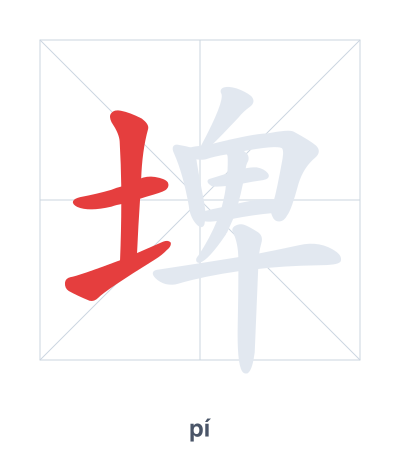
Open Hanzi Writer to see the animated stroke order and practice writing 埤 with real-time feedback.
The character 埤 (pí) is written with 11 strokes. Follow the standard Chinese stroke order: top to bottom, left to right, outside before inside. The radical 土 is one of its key components.
Practice the correct stroke order with the Hanzi Writer app to see animated stroke-by-stroke guidance with real-time feedback.
埤 means low wall / low-lying land.
埤 combines the radical 土 (earth/soil) with 卑 (bēi, meaning 'low' or 'humble'), indicating a low wall or low-lying land. The 土 component shows it relates to earthworks, while 卑 provides both the sound and the concept of lowness.
💡 Memory Tip: Imagine a wall made of dirt (土) that is so low (卑) you can step over it without breaking stride.
这里的土地很埤湿。
zhè lǐ de tǔ dì hěn pí shī
The land here is low-lying and damp.
他住在埤头乡。
tā zhù zài pí tóu xiāng
He lives in Pitou Township.
这对学习有埤益。
zhè duì xué xí yǒu pí yì
This is beneficial for learning.
Open Hanzi Writer to see the animated stroke order and practice writing 埤 with real-time feedback.
✨ Animated stroke order · Handwriting recognition · HSK-graded practice · Free to use
The left component is 土 (earth), which indicates the character relates to land or ground. The right component is 卑 (low/humble), which gives both the sound pí and the idea of lowness. Together, 埤 means a low wall or low-lying land.