捻 (niǎn) means "to twist with fingers; to pinch" in Chinese. It has 11 strokes with the radical 扌.
Rated 4.2/5 in difficulty (advanced).
Appears in 3+ common words including 捻子 (niǎn zi), 捻碎 (niǎn suì), 捻弄 (niǎn nòng).
Due to its 11 strokes, Hanzi Writer's error detection shows 捻 requires focused practice — most learners need 10+ attempts for consistent accuracy.
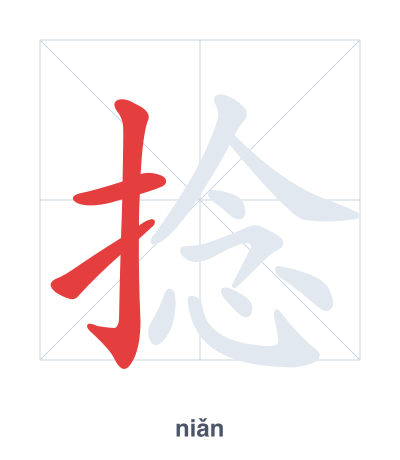
Open Hanzi Writer to see the animated stroke order and practice writing 捻 with real-time feedback.
The character 捻 (niǎn) is written with 11 strokes. Follow the standard Chinese stroke order: top to bottom, left to right, outside before inside. The radical 扌 is one of its key components.
Practice the correct stroke order with the Hanzi Writer app to see animated stroke-by-stroke guidance with real-time feedback.
捻 means to twist with fingers; to pinch.
捻 is a phono-semantic compound: the radical 扌 (hand) indicates the action is done with the hand, while 念 (niàn, to think) supplies the sound. The meaning 'to twist or pinch with fingers' derives from the hand's delicate manipulation, as in twisting threads or pinching small objects.
💡 Memory Tip: To remember 捻, picture your hand (扌) pinching a thread while you think (念) carefully about the twist you're making.
蜡烛的捻子断了。
là zhú de niǎn zi duàn le
The candle wick is broken.
把饼干捻碎。
bǎ bǐng gān niǎn suì
Crush the biscuit with your fingers.
他在捻弄手指。
tā zài niǎn nòng shǒu zhǐ
He is twiddling his fingers.
Open Hanzi Writer to see the animated stroke order and practice writing 捻 with real-time feedback.
✨ Animated stroke order · Handwriting recognition · HSK-graded practice · Free to use
捻 is made of the hand radical 扌 on the left and the phonetic component 念 (niàn) on the right. The hand radical shows it is an action done with the hand, while 念 hints at the twisting or pressing motion, as if pressing thoughts together. Together they create the meaning of twisting or pinching with the fingers.