拟 (nǐ) means "to plan; to draft" in Chinese. It has 7 strokes with the radical 扌, and is HSK Level 7.
Rated 3.5/5 in difficulty (challenging).
Harder than 18% of HSK Level 7 characters.
Appears in 3+ common words including 拟定 (nǐ dìng), 模拟 (mó nǐ), 拟稿 (nǐ gǎo).
Due to its 7 strokes, Hanzi Writer's error detection shows 拟 requires focused practice — most learners need 10+ attempts for consistent accuracy.
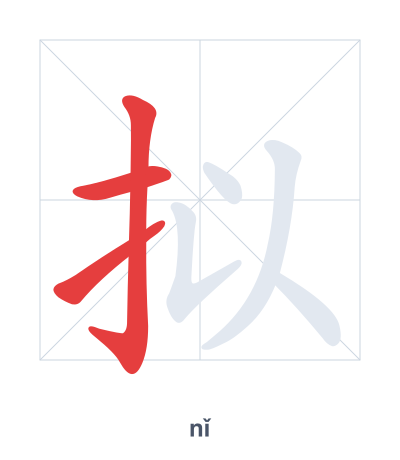
Open Hanzi Writer to see the animated stroke order and practice writing 拟 with real-time feedback.
The character 拟 (nǐ) is written with 7 strokes. Follow the standard Chinese stroke order: top to bottom, left to right, outside before inside. The radical 扌 is one of its key components.
Practice the correct stroke order with the Hanzi Writer app to see animated stroke-by-stroke guidance with real-time feedback.
拟 means to plan; to draft.
As an HSK Level 7 character, 拟 is an intermediate-level character.
拟 is a phono-semantic compound. The left side '扌' (hand) indicates an action, and the right side '以' (to use) provides the sound and suggests the idea of using something to plan or draft. Originally it meant 'to compare' or 'to measure,' later evolving to 'to plan' or 'to draft.'
💡 Memory Tip: Imagine a hand (扌) using (以) a pencil to draft a plan on paper.
计划已经拟定了。
jì huà yǐ jīng nǐ dìng le
The plan has been drawn up.
这是模拟考试。
zhè shì mó nǐ kǎo shì
This is a mock exam.
他在拟稿。
tā zài nǐ gǎo
He is drafting a document.
Open Hanzi Writer to see the animated stroke order and practice writing 拟 with real-time feedback.
✨ Animated stroke order · Handwriting recognition · HSK-graded practice · Free to use
The left side is the radical 扌 (hand), which suggests an action. The right side is 以 (meaning 'to use'), so together they imply using one's hand to plan or draft something.