Hanzi Writer

How to Write 赧 (nǎn) — Meaning “To blush / Ashamed”

nǎn 11 strokes Radical: 赤

赧 (nǎn) means "To blush / Ashamed" in Chinese. It has 11 strokes with the radical 赤.

Rated 4.2/5 in difficulty (advanced).

Appears in 3+ common words including 赧然 (nǎn rán), 羞赧 (xiū nǎn), 赧颜 (nǎn yán).

Due to its 11 strokes, Hanzi Writer's error detection shows 赧 requires focused practice — most learners need 10+ attempts for consistent accuracy.
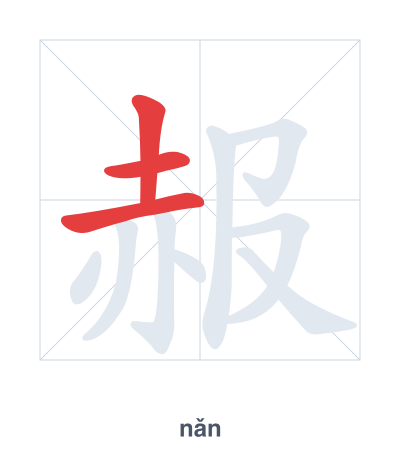
Stroke order practice for 赧 - nǎn

Practice Writing 赧 (nǎn)

Open Hanzi Writer to see the animated stroke order and practice writing 赧 with real-time feedback.

The character (nǎn) is written with 11 strokes. Follow the standard Chinese stroke order: top to bottom, left to right, outside before inside. The radical is one of its key components.

Practice the correct stroke order with the Hanzi Writer app to see animated stroke-by-stroke guidance with real-time feedback.

means To blush / Ashamed.

Character
Pinyinnǎn (nan)
MeaningTo blush / Ashamed
Strokes11
Radical
Difficulty4.2/5

赧 combines 赤 (red) with 㕚 (a hand with claws), suggesting a face turning red from shame, as if clawing at oneself in embarrassment.

💡 Memory Tip: Picture a red (赤) face blushing so hard that you claw (㕚) your cheeks in shame.

nǎn rán
Blushing / Bashfully
xiū nǎn
blushing with shame; shy
nǎn yán
Blushing face / Feeling ashamed

他赧然低下了头。

tā nǎn rán dī xià le tóu

He lowered his head in embarrassment.

她脸上露出羞赧。

tā liǎn shàng lù chū xiū nǎn

A look of bashfulness appeared on her face.

他感到有些赧颜。

tā gǎn dào yǒu xiē nǎn yán

He feels a bit ashamed and blushed.

Character Pinyin Strokes Radical
(current) nǎn 11
shè 11
Stroke order practice for 赧 - nǎn

Practice Writing 赧 (nǎn)

Open Hanzi Writer to see the animated stroke order and practice writing 赧 with real-time feedback.

✨ Animated stroke order · Handwriting recognition · HSK-graded practice · Free to use

Frequently Asked Questions about 赧

赧 is composed of the radical 赤 (red) on the left and 阝 (a variant of 邑, city) or sometimes analyzed as 赤 + 反? Actually, the right component is 辰 (a phonetic element) but visually it looks like 赧 has 赤 on left and 耎? Let’s be accurate: 赧 consists of 赤 (red) on the left and 辰 (a phonetic component) on the right. The left part 赤 meaning “red” directly connects to the idea of blushing, which turns the face red, while the right side provides the pronunciation nǎn.

Characters with Radical 赤

Other 11-Stroke Characters