赦 (shè) means "To pardon / To forgive" in Chinese. It has 11 strokes with the radical 赤.
Rated 4.2/5 in difficulty (advanced).
Appears in 3+ common words including 赦免 (shè miǎn), 大赦 (dà shè), 特赦 (tè shè).
Due to its 11 strokes, Hanzi Writer's error detection shows 赦 requires focused practice — most learners need 10+ attempts for consistent accuracy.
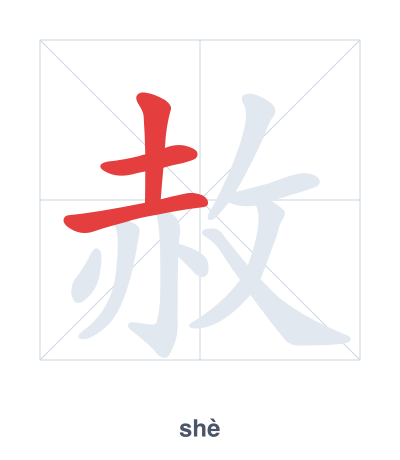
Open Hanzi Writer to see the animated stroke order and practice writing 赦 with real-time feedback.
The character 赦 (shè) is written with 11 strokes. Follow the standard Chinese stroke order: top to bottom, left to right, outside before inside. The radical 赤 is one of its key components.
Practice the correct stroke order with the Hanzi Writer app to see animated stroke-by-stroke guidance with real-time feedback.
赦 means To pardon / To forgive.
| Character | 赦 |
| Pinyin | shè (she) |
| Meaning | To pardon / To forgive |
| Strokes | 11 |
| Radical | 赤 |
| Difficulty | 4.2/5 |
赦 combines 赤 (red, representing the mark of punishment) and 攵 (a hand with a stick, indicating action). Together, they suggest the act of removing those red marks, meaning to pardon or forgive.
💡 Memory Tip: Imagine a hand (攵) wiping away a red (赤) stain of guilt to grant forgiveness.
他的罪被赦免了。
tā de zuì bèi shè miǎn le
His sins were forgiven.
今年会有大赦吗?
jīn nián huì yǒu dà shè ma
Will there be a general amnesty this year?
他获得了特赦。
tā huò dé le tè shè
He was granted a pardon.
Open Hanzi Writer to see the animated stroke order and practice writing 赦 with real-time feedback.
✨ Animated stroke order · Handwriting recognition · HSK-graded practice · Free to use
赦 combines the radical 赤 (red) on the left with 攵 (an action symbol) on the right. The red color was historically used in imperial pardons, so 赤 hints at the idea of a royal decree, while 攵 indicates that pardoning is an action.