腩 (nǎn) means "brisket" in Chinese. It has 13 strokes with the radical 月.
Rated 4.2/5 in difficulty (advanced).
Appears in 3+ common words including 牛腩 (niú nǎn), 鱼腩 (yú nǎn), 腩肉 (nǎn ròu).
Due to its 13 strokes, Hanzi Writer's error detection shows 腩 requires focused practice — most learners need 10+ attempts for consistent accuracy.
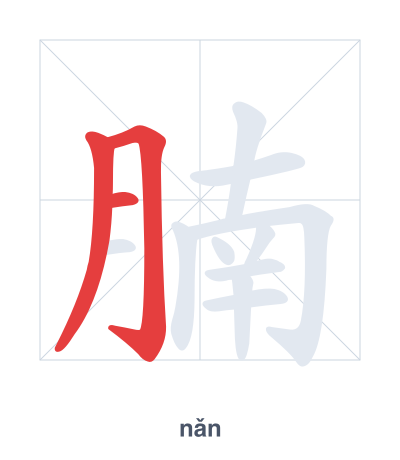
Open Hanzi Writer to see the animated stroke order and practice writing 腩 with real-time feedback.
The character 腩 (nǎn) is written with 13 strokes. Follow the standard Chinese stroke order: top to bottom, left to right, outside before inside. The radical 月 is one of its key components.
Practice the correct stroke order with the Hanzi Writer app to see animated stroke-by-stroke guidance with real-time feedback.
腩 means brisket.
腩 is a compound character. The left radical 月 (肉) indicates it relates to meat or flesh, specifically a cut of meat like brisket. The right component 南 (south) provides the pronunciation nǎn without contributing to meaning.
💡 Memory Tip: Picture a slab of brisket shaped like the character 南, with the meat radical 月 clinging to its left side as a juicy strip of fat.
我喜欢吃牛腩饭。
wǒ xǐ huān chī niú nǎn fàn
I like eating beef brisket rice.
鱼腩的肉很嫩。
yú nǎn de ròu hěn nèn
The fish belly meat is very tender.
这种腩肉很好吃。
zhè zhǒng nǎn ròu hěn hǎo chī
This brisket is very delicious.
Open Hanzi Writer to see the animated stroke order and practice writing 腩 with real-time feedback.
✨ Animated stroke order · Handwriting recognition · HSK-graded practice · Free to use
腩 is a left-right character. The left part 月 is the radical for meat or body parts, indicating the character relates to a cut of meat. The right part 南 provides the pronunciation nǎn, and together they form the word for brisket.