晦 (huì) means "Dark or obscure" in Chinese. It has 11 strokes with the radical 日.
Rated 4.2/5 in difficulty (advanced).
Appears in 3+ common words including 晦暗 (huì àn), 阴晦 (yīn huì), 晦涩 (huì sè).
Due to its 11 strokes, Hanzi Writer's error detection shows 晦 requires focused practice — most learners need 10+ attempts for consistent accuracy.
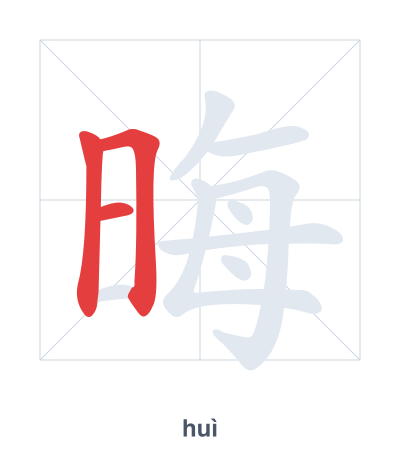
Open Hanzi Writer to see the animated stroke order and practice writing 晦 with real-time feedback.
The character 晦 (huì) is written with 11 strokes. Follow the standard Chinese stroke order: top to bottom, left to right, outside before inside. The radical 日 is one of its key components.
Practice the correct stroke order with the Hanzi Writer app to see animated stroke-by-stroke guidance with real-time feedback.
晦 means Dark or obscure.
晦 combines the sun radical 日 with phonetic 每 (měi). Originally it denoted the last day of the lunar month when the moon is completely dark, giving the meaning of darkness or obscurity.
💡 Memory Tip: Every (每) sun (日) is blocked out, plunging the world into darkness and obscurity.
这里的灯光很晦暗。
zhè lǐ de dēng guāng hěn huì àn
The lights here are very dim.
今天天气阴晦。
jīn tiān tiān qì yīn huì
The weather is gloomy and overcast today.
这篇文章很晦涩。
zhè piān wén zhāng hěn huì sè
This article is very obscure.
Open Hanzi Writer to see the animated stroke order and practice writing 晦 with real-time feedback.
✨ Animated stroke order · Handwriting recognition · HSK-graded practice · Free to use
晦 is a phono-semantic compound. The radical 日 (sun) on top gives a clue about brightness, while the bottom part 每 (měi, meaning 'every') provides the pronunciation. Together, they create the meaning 'dark' or 'obscure'—ironically opposite to the sun's light.