抿 (mǐn) means "to purse (lips); to take a small sip" in Chinese. It has 8 strokes with the radical 扌.
Rated 3.7/5 in difficulty (challenging).
Appears in 3+ common words including 抿嘴 (mǐn zuǐ), 抿一口 (mǐn yī kǒu), 抿着 (mǐn zhe).
Due to its 8 strokes, Hanzi Writer's error detection shows 抿 requires focused practice — most learners need 10+ attempts for consistent accuracy.
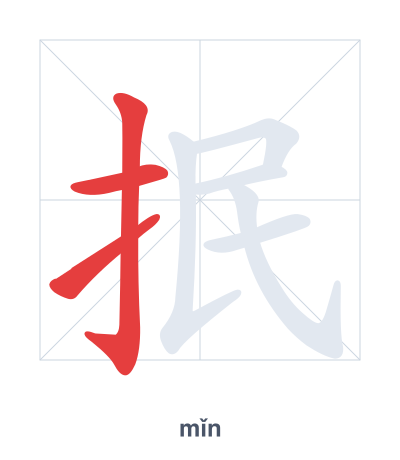
Open Hanzi Writer to see the animated stroke order and practice writing 抿 with real-time feedback.
The character 抿 (mǐn) is written with 8 strokes. Follow the standard Chinese stroke order: top to bottom, left to right, outside before inside. The radical 扌 is one of its key components.
Practice the correct stroke order with the Hanzi Writer app to see animated stroke-by-stroke guidance with real-time feedback.
抿 means to purse (lips); to take a small sip.
抿 is a phono-semantic compound with the hand radical 扌 indicating an action, and 民 (mín) providing the sound. Its original meaning was to smooth or press with the hand, which extended to pressing the lips together or taking a small sip.
💡 Memory Tip: A hand (扌) holds a tiny cup to the lips of the people (民) for a small sip.
她抿着嘴笑了。
tā mǐn zhe zuǐ xiào le
She smiled with her lips pursed.
他抿了一口茶。
tā mǐn le yī kǒu chá
He took a sip of tea.
孩子抿着小嘴。
hái zi mǐn zhe xiǎo zuǐ
The child pursed their little lips.
Open Hanzi Writer to see the animated stroke order and practice writing 抿 with real-time feedback.
✨ Animated stroke order · Handwriting recognition · HSK-graded practice · Free to use
抿 is made of the hand radical 扌 on the left and 民 (meaning "people") on the right. The hand radical suggests an action done with the hand or mouth, while 民 provides the sound. Together they create the meaning of using the lips or hand to press or sip.