缗 (mín) means "cord; string of coins" in Chinese. It has 12 strokes with the radical 纟.
Rated 4.2/5 in difficulty (advanced).
Appears in 3+ common words including 缗钱 (mín qián), 钓缗 (diào mín), 连缗 (lián mín).
Due to its 12 strokes, Hanzi Writer's error detection shows 缗 requires focused practice — most learners need 10+ attempts for consistent accuracy.
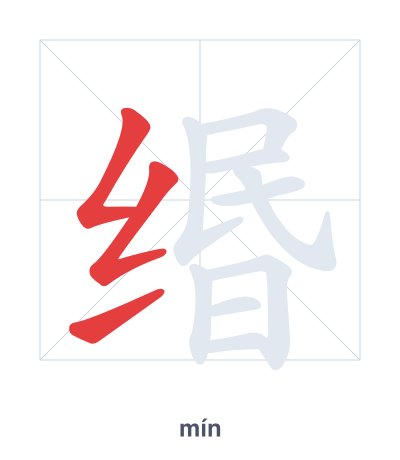
Open Hanzi Writer to see the animated stroke order and practice writing 缗 with real-time feedback.
The character 缗 (mín) is written with 12 strokes. Follow the standard Chinese stroke order: top to bottom, left to right, outside before inside. The radical 纟 is one of its key components.
Practice the correct stroke order with the Hanzi Writer app to see animated stroke-by-stroke guidance with real-time feedback.
缗 means cord; string of coins.
缗 is a compound character with 纟 (silk thread) as the radical, indicating its connection to cords or strings, while 昏 (dusk) serves as a phonetic component. Originally it referred to a cord used to string coins, later extended to mean a string of coins itself.
💡 Memory Tip: Picture a silk cord (纟) tying a bag of coins at dusk (昏), because even money needs to rest at night.
他数了一串缗钱。
tā shù le yī chuàn mín qián
He counted a string of coins.
他拿着钓缗去钓鱼。
tā ná zhe diào mín qù diào yú
He went fishing with a fishing line.
这些钱是连缗的。
zhè xiē qián shì lián mín de
This money is strung together.
Open Hanzi Writer to see the animated stroke order and practice writing 缗 with real-time feedback.
✨ Animated stroke order · Handwriting recognition · HSK-graded practice · Free to use
The character 缗 combines the radical 纟 (silk thread) on the left with the component 昬 (or 昏) on the right. The silk radical indicates that the character relates to threads or cords, while the right part provides the pronunciation mín. Together, they form the meaning of a cord used to string coins together.