幂 (mì) means "Power (mathematics) / To cover" in Chinese. It has 12 strokes with the radical 巾.
Rated 3.9/5 in difficulty (challenging).
Appears in 3+ common words including 幂数 (mì shù), 幂集 (mì jí), 乘幂 (chéng mì).
Due to its 12 strokes, Hanzi Writer's error detection shows 幂 requires focused practice — most learners need 10+ attempts for consistent accuracy.
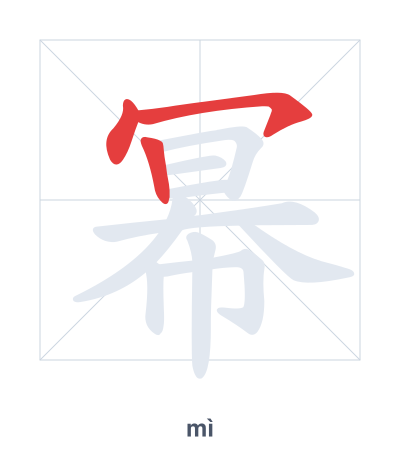
Open Hanzi Writer to see the animated stroke order and practice writing 幂 with real-time feedback.
The character 幂 (mì) is written with 12 strokes. Follow the standard Chinese stroke order: top to bottom, left to right, outside before inside. The radical 巾 is one of its key components.
Practice the correct stroke order with the Hanzi Writer app to see animated stroke-by-stroke guidance with real-time feedback.
幂 means Power (mathematics) / To cover.
幂 depicts a cloth (巾) under a cover (冖), originally meaning 'to cover' or 'a covering cloth'. The mathematical sense 'power' arose from the idea of repeated multiplication covering or layering a number upon itself.
💡 Memory Tip: Picture a cloak (冖) draped over a math book (巾), hiding the exponent inside — that's the power (mì) covered up.
老师在讲幂数。
lǎo shī zài jiǎng mì shù
The teacher is explaining exponents.
这是一个幂集。
zhè shì yí gè mì jí
This is a power set.
学习乘幂的计算。
xué xí chéng mì de jì suàn
Learn how to calculate powers.
Open Hanzi Writer to see the animated stroke order and practice writing 幂 with real-time feedback.
✨ Animated stroke order · Handwriting recognition · HSK-graded practice · Free to use
幂 is composed of 巾 (towel/cloth) on top and a lower part that resembles a cover or lid. The 巾 radical hints at covering with cloth, while the overall structure suggests something being covered or wrapped. This connects to its meanings of 'to cover' and, by extension, mathematical 'power' as in exponential growth under a cover.