脒 (mǐ) means "amidine" in Chinese. It has 10 strokes with the radical 月.
Rated 4.2/5 in difficulty (advanced).
Appears in 3+ common words including 脒基 (mǐ jī), 乙脒 (yǐ mǐ), 苯脒 (běn mǐ).
Due to its 10 strokes, Hanzi Writer's error detection shows 脒 requires focused practice — most learners need 10+ attempts for consistent accuracy.
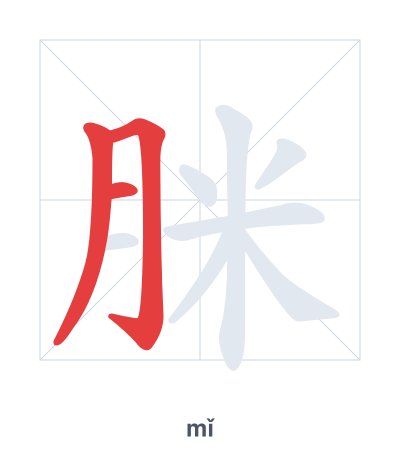
Open Hanzi Writer to see the animated stroke order and practice writing 脒 with real-time feedback.
The character 脒 (mǐ) is written with 10 strokes. Follow the standard Chinese stroke order: top to bottom, left to right, outside before inside. The radical 月 is one of its key components.
Practice the correct stroke order with the Hanzi Writer app to see animated stroke-by-stroke guidance with real-time feedback.
脒 means amidine.
脒 is a modern chemical term, formed as a phono-semantic compound. The radical 月 (meat/flesh) hints at an organic compound, while 米 (mǐ, rice) provides the pronunciation. Together, they represent 'amidine,' a nitrogen-containing organic group.
💡 Memory Tip: Picture a slab of raw meat (月) covered in sticky rice (米), which strangely bonds like an amidine molecule.
这是一个脒基。
zhè shì yí gè mǐ jī
This is an amidino group.
乙脒是化学物质。
yǐ mǐ shì huà xué wù zhì
Acetamidine is a chemical substance.
苯脒的用途很多。
běn mǐ de yòng tú hěn duō
Benzamidine has many uses.
Open Hanzi Writer to see the animated stroke order and practice writing 脒 with real-time feedback.
✨ Animated stroke order · Handwriting recognition · HSK-graded practice · Free to use
脒 is made of the radical 月 (meat/flesh) on the left and 米 (rice) on the right. In chemical terms, 月 often appears in characters for organic compounds, and 米 provides the pronunciation mǐ, while the overall meaning 'amidine' is a scientific term unrelated to flesh or rice.